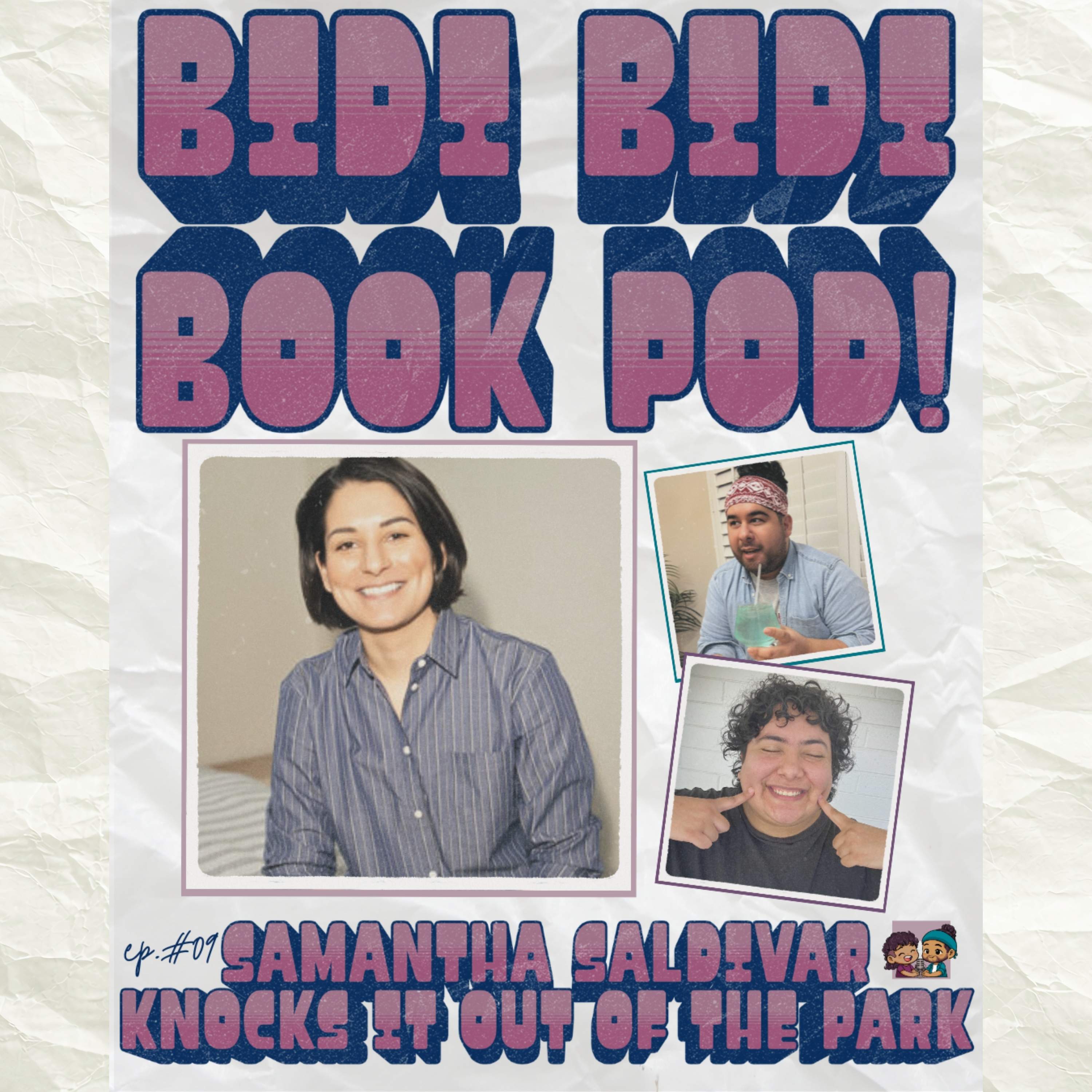
Today we had the pleasure of chatting with Samantha Saldivar! Tune in for all things Sapphic sports romance, Sam’s origin story, and centering our favorite underrepresented stories.
Links:
Sound credit: WALLA Ballpark Organ Take Me Out to the Ballgame by AshFox — https://freesound.org/s/191927/ — License: Attribution 3.0
Transcript
Hello and welcome to the Bidi Bidi Book Pod, a bookish podcast committed to celebrating queer and trans BIPOC stories and storytellers and sharing our experiences within the publishing industry and what it is to exist as a queer trans BIPOC creative today.
novels and romances including:Sonido:And my name is Sonido Reyes, bestselling and award winning author of the Lesbiana’s Guide to Catholic School, the Luis Ortega Survival Club, the Broposal, The Golden Boys Guide to Bipolar and the forthcoming To Our Untamed Core.
And together we are so excited to spend some time with you, with friends and in community to chat chismear and make that TBR pile bigger and more diverse. Today we are joined by Samantha Saldivar, USA Today bestselling author of Play You For It.
Her most recent release, Running Home to You, released May 19.
We talked about Sam’s origin story, how sports are better when they’re queer and that they’re all gay, Sapphic romance and centering ourselves when publishing tends to underrepresent us.
Jonny:But before we bring Sam in, let’s start, as always, with a platica, a moment to catch up with each other and with y’all, to bring you into our lives as authors and what we’re working on and maybe overshare bit. So, Soni, what’s going on with you? What are you working on? Tell me everything.
Sonido:Well, I am still working on my adult. My next adult release, I should hope. I did get some extra time with that.
I’m hoping to finish that within the next month, but it’s just taking a lot longer than I expected. Like, it is the most twisty turney book I’ve ever attempted.
And so I literally was not prepared for it to take longer to write the same amount of words that I’m used to writing. So I just had to.
Jonny:This is your sapphic one, right? The one I’m thinking of.
Sonido:Yeah, it’s the. The telenovela
Jonny:Yes. Okay.
Sonido:And it is just full of plot twists and campy fun surprises.
And it’s like, it’s just so complex that it’s taking a long time because I have to make sure that I’m weaving through all those complexities. Complexities in a way that doesn’t confuse the reader, but that also doesn’t, like, feel like too much. Like, to comprehend.
Like, it has to be easily understood. So, yeah, I’m just kind of like weaving things through and it’s a slower drafting process than I’m used to, but I am enjoying this story a lot and I can’t wait to share more about it once I. Once I finish it. Yeah. What about you?
Jonny:I am fighting myself. Probably going to be very busy the next couple of weeks.
I ended last week with a phone, like a zoom chat with an editor and an email from another editor. And. Yeah, so probably going to be pivoting real hard on one book, probably. Just realizing that nothing in publishing is cemented until that book is on the shelf. So probably lots of news at some point about that that’s just going to be really vague for right now and then just trying to.
To make another book a little prettier. But, yeah, it’s very. Lots of things happen.
It’s like I prepared these two proposals, like, at the beginning of the year, late last year, and then sort of just heard nothing for eight weeks, 10 weeks. And now all of a sudden, author life is like, okay, we either have nothing to do or we have a thousand things to do.
Sonido:Yeah. All of the things at the same exact time. And they have to be done now, immediately.
Jonny:Yeah.
Sonido:Publishing. Publishing is exactly the same thing as when you go to the gas station and you’re gassing up when you.
When they used to have the card readers that you would put in and be like, do not remove. Do not remove. Do not remove. Okay, rapidly take it out right this instant or I’ll kill you.
Jonny:Yeah. When it’s like screaming at you.
Sonido:Yes. That’s what publishing is. It’s like don’t do anything, don’t move. Nothing is happening. It’s so boring.
And then suddenly, all, everything at once, you’re going to die. Like.
Jonny:Yeah. And at least it’s very. At least it’s very exciting. Screams.
Sonido:Yeah. Yeah, yeah, yeah.
Jonny:And not like terrifying screams. But yeah, lots to work on in the next few.
In the remainder of the month that I’m very excited about.
Sonido:Excellent.
Jonny:Yay. That’s us. And now pivot.
Sonido:Cute. Now we’re so excited to bring in Samantha Salivar. Thank you so much for joining us, Sam.
Samantha:Yeah, thank you.
Sonido:We’re super excited.
Samantha:So, yeah, be gentle. But no, I’m really excited to join. Thank you.
Sonido:Yes, thank you. And for any of our listeners who might be meeting you for the first time today, can you just tell us a little bit about yourself?
Samantha:Yeah, yeah. So I’m a author out here in Portland, Oregon, where I was born and raised. My debut novel, play you for it, is another Sapphic sports romance, came out in October. It’s a love story between a woman or a woman who’s the coach of a men’s basketball team at the D1 college level.
It’s never happened before in real life, but I was inspired by coaches like Nikki Hammond or assistant coaches or women in the NBA. And then kind of the romance factor is there’s a sports reporter who really wants to have the first sit down with. With Jordan, the coach.
And their love story goes from there. Then I have a second book called Running Home to You that’s more of an epic love story that comes out on May 19.
But outside of that, I work in broadcast production. I used to be a journalist, actually. I worked in TV news locally here in Portland and down in Eugene in Oregon.
So that definitely informs a lot of my work. And I’m just a huge sports fan. Sports movies, watching sports, playing sports. So obviously you’re going to read a lot of that in my work.
That’s why I’m in sports romance.
Sonido:Excellent. And you actually answered my second question was about. Tell us about Running Home to You. So super exciting.
This episode is going to air just after this comes out. So by the time everyone’s listening, you can go buy it and read it right now. Everybody.
Samantha:Please do. I can dive in a little bit more into that. I guess I kind of kept it brief.
Jonny:Yeah, absolutely.
Samantha:Yeah. Running home to you. I’m really excited about this book. Play You for It was really fun. I feel like this one’s a little deeper emotionally.
So it follows these two young women who meet at college campus on the softball team.
One of the leads, Abby, she’s like this really kind of like generational talent who comes and transfers this school after kind of going through some personal struggles. And she is competing for a spot against our other lead, Kate, who’s like been just working so hard and dying to be shortstop on the softball team.
And of course they’re going to clash like enemies to lovers sort of situation,
Sonido:Of course.
Samantha:But they end up helping each other and, you know, falling for each other. But you kind of come to realize they both have some really heavy things that they. They need to work through first to be together.
It becomes pretty apparent. And their love story, or just the ups and downs, stretches over like eight years. Like we follow them past college and. And into the.
Into the future and see where they land. So definitely more of an epic, Play You for It covers like one basketball season. So it’s like, you know, really sped up.
And this was kind of fun to take my time with and stretch over a really long period of time and stay with these characters for a while.
Sonido:Yes. And honestly, like, with a title like Running Home to You, it, it just already gives like very like epic, you know, like, it’s like the home stretch.
I don’t know.
Jonny:Yeah. And like, I love like the double meaning of it. Like.
Sonido:Yes.
Jonny:Yeah, like. And I, I’m honestly, I think emotional is just such a one accurate word for it. I’m finding it to be like such an emotional, impactful and really compelling story that’s like gorgeously blending sports and love.
Um, I’m really enjoying reading it and I’d, I’d love to hear like the, some of the inspiration for Running Home to You and the process of writing the story. I know a lot of authors have like a lot of trouble with book two and like, what was, what was that sort of process like for you?
Samantha:Yeah. So book two is basically kind of in the can and written before book one sold. So it’s kind of. And I had a two book deal.
So after Play You for It, I kind of had this chance to be like, I don’t know if this is what publisher is looking for. I know it’s a different feel than Play You for It.
I wouldn’t say it’s less fun, but again, there’s some like, deeper themes there a little longer, so snuck that in. Fortunately it worked out.
But I guess the inspiration behind it is both personal and then just, I don’t know, my love of sports and specifically softball. I played a lot of softball growing up. My dad played baseball, my mom played softball. Yeah. So.
And I think, I don’t know if you watch a lot of sports movies or anything like that, but there’s always kind of something mythic about baseball and softball. Like if you build it, he will come and it ends with him playing with his dad in the outfield.
And you cry, or I cry at least, you know, or you know, Moneyball is the quote from Brad Pitt. How can you not be romantic about baseball? So I find baseball and softball to be really romantic.
So, it was a perfect fit for this kind of story that I wanted to write. But it was a very organic kind of piece. And for me it was also working through some, some of my own grief.
You know, I lost my mom in my early 20s and not to spoil too much, but so does Abby. And this was a way for me to sort of process that.
And also just the inheritance of having the, the game in your family and, and how it’s, you know, very much a parallel to life, and a way to play through the grief, a way to understand, you know, second chances and striking out and all the. All the cliches. But it really does apply. And for me, it’s kind of like a spiritual. A spiritual game. And it was really fun to write about. I don’t know.
I think I just never went there, but I’m always very passionate about that aspect of the book, so it was fun to bring that to life, and that’s where it came from.
Sonido:I love that so much.
Jonny:I’m also just, like, really deeply in love with your protagonists, Abby and Kate.
I think that they’re incredible characters, and just like how you make this story so much about their humanities and their traumas and their hopes just as much as it is about, like, softball and them falling in love. And I. I just think that they’re just. It’s impossible not to root for them and want to exist alongside them. And so, like, what.
What was your process for developing them both, like, as a pair, but, like, as two very much, like, alive individuals? And what was your journey like for you as a storyteller, getting to spend time with these characters and getting to know them?
Samantha:Yeah, it sounds really simple, but I think I knew I wanted them to be kind of represent opposites. So just starting from that place made it very, like, you know, one of them is very hot, one of them is very cold. One of them’s a great student.
One of them. One of them is a terrible student.
One of them is very, like, future focused and has their eye on the prize, and the other one has no idea, like, where they’re headed or how to even get out of their own way to get to that place. So I kind of started there.
And I love characters who have layers, who make mistakes, who crash out in front of you and you’re so frustrated, but you can still root for them.
Sonido:Yes. I love a messy character.
Jonny:Yeah.
Samantha:Oh 100%.
Sonido:You know, that’s my favorite thing.
Samantha:Oh, yeah. So that was. That was part of it. And I did want to make sure, you know, they each had their own journey to go through.
I’m really passionate about that when it comes to romances. I love the romance genre and the happy ending and. And, you know, bringing two people together, especially if they’re polar opposites.
It’s always a fun trope. But I really like.
Sonido:Especially when you add in the rivalry element, too. Like.
Jonny:Yeah, yeah.
Sonido:It just works so well.
Samantha:It’s very natural. But I wanted something. I always want, like, individual growth as well. Like, you know, they’re on their own paths.
They have their own ambitions, their own demons, their own like troubles that are, that are totally unrelated to the other person or I guess in some ways they are a little bit related. Like it’s going to affect the relations, but really it’s about like they gotta dig deep through themselves.
You know, like I said, Abby’s kind of dealing with grief on her side of the street and Kate’s, you know, comes from like an extremely religious household, was raised very conservatively and meets Abby and it just kind of like blows her mind and you know, blows up her world in that way. So that’s kind of how I approach them. And then just still, you know, I, I really love them too.
They’re really easy to, to be with for that long of a book and felt like I knew them so well. Like I didn’t want to part with them either.
Sonido:Oh, I mean, you don’t have to maybe like a, perhaps a spinoff.
Jonny:Yeah. And I, if I get, I want to just like what, what sort of like made in my head, like it fit so perfectly.
But like did you always envision starting them, like going back and giving them that introduction while in college and playing softball there? I felt like it was sort of like a perfect moment for like it just.
I think it just resonates with like anyone who’s sort of been there and like, yeah, I am fully both. These are the two wolves that live inside of my head as a college student.
But like sort of like what made you start at that point rather than in anywhere else in their career?
Samantha:Yeah, I wish I had like a direct answer. This one. I would say with this book, compared to some of my other books that I’ve written, I definitely didn’t plot it out as much.
It definitely just kind of like poured out from the heart. And that’s another reason this one’s so like close to me. I think I just started writing and I knew I wanted to write a softball book.
I knew I wanted to write about this character named Abby. And I just kind of like started writing and it just felt so natural that like of course they’re going to meet on the field.
And I love that you said the two wolves inside me because they are kind of like the two sides of myself. I feel like. And probably a lot of people you can kind of, you know, we all kind of have our self destructive part of us and we have the.
Not the meaker, I don’t want to say, but the part of us that’s holding back a little bit for one reason or another. And I think.
Jonny:I feel like especially so for queer people.
Just, like, the side that resonates with, like, Kate of, like, having all these sort of expectations that we’ve lived with and the way that we’ve kind of tried to mold ourselves to how everyone wants to see us. And then Abby, where we kind of, like, are realizing that that just kind of hurts.
Like, all the ways in which, like, we’ve lived up to now sort of hurt to exist in. And, like, I just felt like it was. Yeah, like, they. They just were so. Both so different, but, like.
And I think they’re gonna both, like, connect with people just so deeply and profoundly.
Sonido:100% agree. So you did mention a little bit how both your first book and this one and even your next book, Giving up the Game are all sports romances.
So, and you did talk about how you grew up playing, like, softball. Did your lore, like, tell me about your, like, your. Your lore with, like, softball or any other sports you played.
Like, how does that bring you to your stories as a writer?
Samantha:Yeah, I don’t have any, like, great lore. I wasn’t, like, amazing, but I just, like, loved playing, you know, like, it was just so. It just defined me for so long.
Playing softball and playing soccer. Those are my two big sports. But in addition to that, I really wanted to go into sports journalism and be a sports broadcaster.
So I actually, like, in high school, I would broadcast high school football, basketball, baseball, like, whatever I could do. It was really fun. It was like a club, and it was just me and, like, a microphone and a headset and a audio mixer.
And, like, yeah, it was really early streaming. I can’t even remember the streaming site we would use, but, like, football players, parents would watch. Yeah, it was really fun.
So that was so much part of me. And I went to. Went to college at University of Oregon and majored in journalism with the intention of going into that.
So did campus radio, a lot of the same thing, you know, broadcasting women’s soccer, softball, and campus tv. I did that as well. I ended up kind of getting burnt out by the end, if I’m being honest.
And I pivoted to news production, which I think was the right move for me, because I just started to get a little tired of writing about the same, like, wins or losses, or you interview the players and they’re saying the same thing after every game. And it’s late nights and it’s weekends, and, I have a lot of friends who went into it and did great.
But all that to say that’s kind of the lore behind where that’s, like, the engine of a lot of these sports stories is. You know, I was always on the sidelines, even when I wasn’t playing.
I was also interviewing coaches or talking to players or, you know, again, I just still watched a lot of sports.
I think getting out of it might have been, like, the secret sauce, though, of, like, oh, that’s what I needed to do to have a little bit of, like, joy again.
Sonido:Yeah. The distance. 100%.
Samantha:Yeah. There’s so many stories, like, on a court, you know, you watch any game, like, there’s just a billion storylines going on, and.
Sonido:Yeah, I think I feel like I feel that heavily.
Samantha:Yeah.
Sonido:Because, like, okay, so, like, I also played softball growing up, and I just, like, that resonated so heavily. Like, sometimes you just need distance to be able to enjoy something that you once loved.
Jonny:Yeah.
Samantha:100%.
Sonido:Because, like, my dad was my coach. Like, it was rough.
Jonny:Yeah. My grandpa was an umpire for, like.
Sonido:Oh no.
Jonny:So, yeah.
Sonido:Oh, man. Yeah, like, that. That’s. That’s a, that’s a rough life sometimes. But like.
Samantha:The car rides home are long after that.
Sonido:Yeah.
And then I think even, Even, like, now, like, if I didn’t, like, quit playing, like, I feel like I wouldn’t even be able to, like, you know, enjoy these kinds of books and just, like, fully feel it and. Because it’s like, I like what you said earlier about, like, the, the romance of the sport itself.
Like, not even just, like, the romance between the characters, but of the sport. Like, that is something that is just. I just. I just love that you said that, and it, like, feels really special, and I 100% agree with that.
Especially with, like, softball and baseball for some reason. I don’t know, it just, like, feels like there’s something, like, you said, like, where did you use mystical or, like.
Samantha:Kind of, like, mythical? Spiritual.
Sonido:Mythical, yeah. Like, it’s spiritual. It’s like. And it’s. Maybe it’s because.
Because it is, like, people say it’s, like, the, like, boring or whatever sport, but it’s like, there’s something to it of just, like, going and. I don’t know. Yeah, So I love that. But then on top of that, like. And actually, you know what?
I, I, I didn’t plan this question, but I want to, like, dive deeper into that, like, mythicalness of the sport. Like, can we talk about that?
Because that’s just, like, so interesting and especially for people listening who maybe don’t know anything about sports or are just, like, interested, like, how. What would you tell them about that?
Samantha:Yeah, I would say with softball and baseball specifically, like you mentioned, it goes so slow. Like, nothing happens until it happens, you know, like, and you almost have to find this, like, especially when it comes to hitting or even fielding.
Like, you’re out there with everybody, but when the balls hit to you or when you’re, like, up to bat, like, you are so alone. And you kind of have to have faith in yourself and faith in the game and. Which sounds crazy. Like, I. Sometimes I feel like I sound like some weird.
Sonido:No!
Samantha:Like, I believe in the church of softball. And. Yeah, you. It’s definitely. You kind of have to get over yourself.
I say sometimes you have to be a little bit stupid to play these sports and to get in the box and get a hit, which kind of feels like faith sometimes. I’m not saying, like, it’s stupid to have faith, but you kind of have to, like, let go of something in your brain to really.
Sonido:Yeah.
Jonny:Absolutely.
Samantha:To fall for the sport or fall for whatever your belief system is. There’s like, this beautiful middle ground. And I think hitting a baseball or softball, they always say, is one of the hardest things you can do.
And it’s so solitary. And I think for those reasons, it just really always hits me as kind of that mythical spiritual experience.
I don’t know if you guys relate to that, but, that’s kind of where it comes from. Again, I don’t know if this is going to land with anyone who hasn’t played sports or is like, oh, my gosh, she sounds cuckoo. But.
Sonido:Well, I mean, if they read your book, I feel like that’s like, you don’t have to, like, know a sport in and out to like, that’s the fun of it is like reading it in a book if you. If you aren’t an athletic person or whatever.
Like, you get to enjoy it just with your eyes or your ears if you’re listening to it. But yeah, for me, it’s like the ritual of it that feels kind of like, you know, like, ritual feels quite spiritual to me, too.
And then I guess that kind of, like, ties into. Of like, what about this sport or any sport, really? Like, sports make such a good platform for specifically queer storytelling.
Samantha:Oh, my gosh. Yeah, I love that also. I just love that you said ritual, because I. I totally 100% usually would say that, too. The ritual.
Like, everyone has their little thing that they do not just in softball, but baseball. There’s a lapse. We have all of our. And, like, superstitions, too. Like. I’ve always had lots of superstitions.
Jonny:Baseball is the Catholicism of sports, actually.
Sonido:Oh, my God. It really is. Oh, my God. Can we, like. Is this, like, sacrilegious to, like, say what each Sport’s religion is.
Jonny:Oh, we might.
Samantha:Oh my gosh. I don’t know.
Sonido:Baseball is definitely Catholicism though.
Samantha:Yeah 100%. Yeah. That’s so crazy. Oh, my gosh. That was profound. Okay, I’m gonna use that.
Jonny:That might have to be the title of the episode.
Sonido:Yeah. Baseball is the Catholicism of sports.
Samantha:I love that.
But, yeah, as far as important for queer stories, you know, in that intersection of sports, I would say I mostly feel, you know, as a lesbian, that was kind of. You know, sports for women can really be, like, empowering, I guess, or really freeing.
You know, I played on a lot of softball teams, and I feel like half of us were queer, you know, and it’s just a place where you can be so free in your body and I don’t know, I never felt judgment.
I never felt bad for playing too hard or for trying to beat the boys or for just, like, not really caring or for walking around like a dude when really I’m just walking around like an athlete or caring about my sport. I feel like identity kind of. I wouldn’t say it disappears, but it’s just. It’s almost like we’re all on the same playing field, literally.
Sonido:Yeah.
Samantha:So I think, you know, sports were so important for me because that’s where I felt most like myself. I felt comfortable with who I was.
And that was before I even really realized, you know, or wanted to be honest with myself about, you know, what my sexuality was.
And just being surrounded by other people who were so confident in who they were and positive about their sexuality and just completely shameless and proud of it really, you know, changed kind of the way I think I approached it. And I came out much sooner, I think, because of that.
hat time, in the early, like,:I was playing, like, club sports. So, yeah, I think that’s.
That’s where it’s important, I think, for me, or where I can really, like, kind of infuse it, it just feels like a natural intersection for, like, Sapphic romances. For sure.
Sonido:100%.
Jonny:I. I think maybe, like, one of my favorite things about sports romance in general, is the teammate relationships. Like, I love a platonic relationship, a friendship. I’m always going to be the person who the side characters end up being my favorite.
And, like, characters like TK And Mick, like, already, just immediately were like, yeah, these. I love them. And I think there’s something about it coming, like, specifically from teammates, always seems to, like, hit so perfectly in the feels.
The humor, the tension, the homoeroticism, like, all of it.
Sonido:It’s a perfect recipe for, like, found family.
Jonny:Yeah. Yeah. Can you talk about, like, Abby and Kate’s teammates and how they help bring their world to life?
Samantha:Yeah, totally. I mean, and I think you nailed it there, too.
It’s just like, I was so inspired by all the goofballs I played with growing up and just the inability to take anything seriously, but also just be the first to know what’s going on with you, to, like, punch you in the shoulder and pat you on the back and, you know, not having to say much and just getting on the field and, like, playing together and that being kind of the relationship or how we understood each other. And then you just throw in, like, all the traveling and the bus rides and the tournaments at hotels and just screwing around.
Like, some of the best memories are with that found family and in Running Home to You. Yeah, they’re definitely kind of like a cast of characters. I feel like Mick is sort of the. The comedic relief often, but she’s also in the middle.
And that’s what’s kind of funny with this friend group especially. They’re just kind of in the middle of Kate and Abby.
Like, they know all this stuff is going on, but they’re just trying to, like, be supportive of them both. But, like, geez, we’re in the middle of this too. It’s kind of like a disaster at times. It’s great at other times.
But, yeah, Mick’s definitely the comedic relief, I would say, and kind of like the ringleader of their little group. And then you have TK who is, oh, I wonder if their positions really matter. But, you know, Mick’s a catcher, so that’s kind of like, you know, the.
The leader of the field in a way. And then TK Is a pitcher.
And I always joke because my mom was a pitcher, and obviously I grew up with a lot of pitchers, but they’re kind of airheads sometimes.
Sonido:Oh, my God.
Samantha:No offense to any pitchers out there. But at least the one I wrote is, like, that kind of airhead, she’s a little, like, self obsessed. And then. Then Jill’s the first baseman, so, like, you know, just reliable, Always there at first base, kind of, like trying to smooth things over.
So I feel like their positions and. And their characteristics kind of balance out who they Are. And. And they’re just always kind of there.
I. I almost wish I could have included more of them with Kate and Abby, but the book can only be so long. Yeah. But, yeah, I had a fun time writing them, and they play such a huge role, especially for Abby, who, you know, doesn’t have.
Well, I guess for both of them. Abby’s home life is sort of, like, in flux and not exactly stable.
And Kate, you know, has a large family, but again, they’re very conservative and religious and. And not necessarily people she can turn to for the support she needs, you know, at certain points in the book. So the.
The found family comes into play. And I love doing found family. Like, I think every book best.
Sonido:Best. Best trope. I love it.
Jonny:Best trope.
Samantha:Like, the team is just like, you know, basically as much a character and story as the leads are.
Jonny:Absolutely.
Sonido:And found family, I feel like, especially in queer stories, is. Is incredibly like. It’s like an extra layer of, like, importance, I think. Just. Yeah, it hits.
It hits harder for me when it’s like, a queer story that found family piece.
Samantha:Yeah. No, I feel the same way. It’s like, I don’t know. And I’ve.
I’ve been really lucky, like, with friends that I consider basically just, like, sometimes, you know, more reliably there than, like, other members of family. Like, and when you grow up with people, too, I think, you know, the story is a college story.
You know, we talked about being on a team, but also just being in those formative years of, like, you know, your late teens to your early 20s, where you’re still figuring out who you are and how to be an adult and, like, who you’re going to be and the people that you’re coming up with during that time, and you meet those people who are like, wait, wait a second. Like, you get it. Like, you’re gonna be around for a while. I think there’s something really sweet about that, too.
Jonny:Absolutely. I. I like asking this, recognizing that there’s sort of like, everyone has their own opinions about this.
But where to you is like, the perfect balance between writing a character with a love for the sport they play and that character falling in love with a person?
Or, like, in other words, do you think there’s a firm line for when a sports romance becomes overloaded with scenes and games, matches, practices, or just in that world, or does that limit not exist?
Samantha:Oh, my gosh, I wish it didn’t exist. First couple attacks I took at sports romance. I was like. It was like 80 soccer games, and then like.
Like, to the action Like I was writing it like a sports journalist. Like these games are so interesting though, don’t you want to like see another goal? So I do think there’s a line only because I can overwrite the other direction.
But I do, I will say I don’t always like in sports romance, if the sports just kind of like window dressing or something or just like kind of like background to make the character seem hotter or it’s just fun because they’re in a uniform or something like that. Like I, as we’ve been talking about, obviously I’m very passionate about softball, but felt the same way with, you know, basketball in Play You for It.
Feel the same way about soccer in Giving Up the Game. Like, I really like it to be still an engine that’s keeping the book going.
Like, you know, every game still means something to the characters and is either pushing them one direction or the relationship one direction, but not being the whole focus. So I don’t know if that’s necessarily defines the line, but that’s kind of how I try to approach it.
Like, make sure it’s still like driving the plot forward or using it as the, the device in the plot. And then I think in that way it usually keeps it pretty balanced. But I struggled with that for a while. In the other direction of like two much sports.
Sonido:I mean that makes a lot of sense with your background. I’ll be like, make. Yeah. So we are in like the height of the Heated Rivalry hype right now.
And I think there are a lot of like really well intentioned, like hopeful takes are saying things like that these adaptations and you know, Heated Rivalry, Red White and Royal Blue.
Like lots of these, like, adaptations of like queer stories that they’re going to bring, they’re going to lead to more queer stories being given this opportunity. But we’ve seen all too often that these opportunities don’t always come for BIPOC stories or especially sapphic stories.
And knowing this, we still, you know, write our stories.
So I wanted to ask, like, what about being a storyteller that specifically centers sapphic characters and that centers Latina characters, resonates with you and like what’s your why in continuing to write these stories in an industry that criminally underhypes these types of stories.
Samantha:Yeah, I think I just like believe it’s going to happen eventually, you know, and I know it’s not happening on the. Yeah, it is, it is. I. I just have no doubt, like, I have full belief, like it’s gonna happen. I just, it might not be on our timeline.
And even when, you know, you look at something like Heated Rivalry or Red, White and Royal Blue or. Or the more like, Achillian stories that are, like, getting a lot of spotlight. I like to think, like, it’s still a step in the right direction.
It just might, like, take a while and not. I’m not trying to be, like, too positive, because, like, it still is a reality that.
Sonido:Right, right.
Samantha:Sapphic stories aren’t necessarily getting the platform.
But I think in general, too, like, this was just a passion of mine in general, like, when Play You For It came out, people were like, oh, like, with Caitlin Clark and all that happening, like, how. What great timing. I was like, no, I was just already. Because I loved it.
Sonido:Right.
Samantha:Caitlin Clark wasn’t even born when I was writing this. I’m just kidding. It was just like before that. And the WNBA is taking off.
Sonido:Yeah.
Samantha:I think just women’s. Especially sports. I mean, I will just say women’s sports in general.
I think fans are showing again and again, like, they want to see women being strong and winning and competing and even getting, you know, in fights or having controversy. Like, all of its positive.
I don’t want to say all press is positive press, but, you know, the conversation is happening and I think it’s getting more consistent and louder and. And eventually someone’s going to be smart enough to be like, okay, it’s time to give this story that treatment.
Obviously, there’s an audience here for it.
Sonido:Right. The people want it.
Samantha:I believe that’s going to happen. And in that case, like, I’m just still going to keep writing what. What I like to write, and I write the stories that, like, I always wanted to read.
And that’s really where it all comes from. I mean, representation and all that’s super important to me. But I think I just come from a place of, like, this was what I wanted to read.
And fortunately, other people want to read it too. And, you know, if publishers want to keep taking a chance on it and supporting me, like, I feel really, really lucky in. In that lane.
And hopefully it just keeps growing and more people keep, like, coming in. Because I think that’s what it’s gonna take.
Sonido:Yeah, for sure. And I think, like, trends come and go. Right.
But I. I think it is really one way to kind of, like, not necessarily get ahead of a trend, but, like, if we’re still writing our stories and we keep putting out our stories, like, when the trend swings our way, we’re gonna catch it, you know, because it’s impossible to write to trend with how long it takes to write and publish a book. Like, there’s no way to know what is gonna happen in the world by the time your book comes out. So like, we just gotta keep going.
And then like when eventually that pendulum swings, like we’ll, we’ll catch it. We’ll have to catch it.
Samantha:Yeah. No, I love that. I think that’s so true.
And I know it’s such like, it’s always repeated like write what you know or write what you like, but it’s so true. Cause if you try to write to trends, it’s just. I think it’s also obvious when someone’s writing to.
To trend or trying to like hit a certain trope or a certain theme or something and like just crank out what they think is going to stick versus, you know, I think the world just like comes back around. I believe in like positive thinking and all that. So. Write, write to what you want to write to, I guess.
Jonny:Absolutely. Good, good. Like tip for listeners too who are like wanting to write. Like just write what you want to write.
Sonido:Yes, yeah.
Samantha:Yes, exactly.
Jonny:And I think too like with stories like yours, the ones you’re publishing, books like Cleat Cute by Meryl Wilsner and one of my like all time favorites, Honey Girl by Morgan Rogers, there’s like no shortage of incredible Sapphic love stories and romances. But I do feel like they’re in these circles of social media that at least I end up in.
There’s no lack of louding for gay and Achillean romances, while support for love stories centering queer women seems to be much quieter. But, and I think you’ve touched on this a little bit through some of your answers.
But like, what to you make Sapphic romance in particular uniquely powerful and beautiful?
Samantha:Oh man.
I think, I mean, I feel this way about all queer romance, but just it really comes down to like choosing yourself a lot of times in these queer romances.
Not that that doesn’t happen in straight romances, but I think in queer romances that’s just like baseline, like to pursue a love that’s not always outwardly accepted by either society or family or religion or whatever your baggage is going to be, you’re really choosing yourself at the end of the day, not just choosing a person. And I really love that in a romance. I think it gives it so much more grit. I think it’s so much more powerful.
I think it just makes the genre stronger. So that’s why I think Sapphic romances, but just queer romances in general so important.
And I guess from a Sapphic perspective, it’s like I, I do love that moment for women who are just like, this is who I am and like, let me go for it. And I think, you know, women need to see more of that.
And I, I hope, you know, we can get all women on board with more like Sapphic stories, just like support for like Heated Rivalry, maybe seeing it from that lens or realizing, you know, that’s actually what’s at the core of these stories. You know, Heated Rivalry is really sexy and fun and you know, HBO did a great job and obviously lots of people liked it, I liked watching it.
But also at the core of it, there’s a lot there of like, you know, these two guys like choosing each other despite this whole like, ecosystem around them, especially in sports, that would probably suggest otherwise. And I think, women need to see that too.
Sonido:Yes, we’ve said this like so many times on this podcast, but like, you do not have to see yourself or relate to like the main character in order to like fully enjoy a book. So like, you don’t have to be like, like a queer woman to enjoy Sapphic romance or a queer man to enjoy, you know, Achillean romance.
It’s like support the ones who are. And yeah, also bouncing off a little bit of, of your point, Jonny.
And we do get a little spicy on this podcast with our take sometimes, but like with the caveat, like there’s always nuance, right?
And I’ve noticed like in my personal social media algorithm algorithms, it seems like there is kind of like a double edged sword when it comes to queer representation because you have like on like we talked about this like pendulum swing, right? On the Achillean romance side, there is like a lot of hype, but also a lot of like fetishizing.
And the money doesn’t always flow to Achillean authors, so it’s not necessarily flowing to the people who are writing from their own experience.
Whereas on the Sapphic side of things, like it seems like most of the authors who are writing Sapphic romance are writing it from their own lived experience. But it is like I said, criminally underhyped. It gets like a lot more ignored. Not as much like marketing push from publishing.
So to kind of like rectify that.
And we can like dive into that conversation if y’all want to, but I kind of wanted to just like say that to, to, to give a, an excuse to rectify the under hyping of Sapphic stories. And can we all give like a little TED talk of like your favorite Sapphic story or love story?
Samantha:Oh man, I don’t know if I have a favorite I just have, like, authors that I’m always trying to, like, hype. Like, you know.
Sonido:Yeah, hype em up.
Samantha:Like, Allison Cochran’s great. Anita Kelly.
Like, you know, of course I have to throw in, like, the people who I feel like, really were the first sapphic books I read, which was Meryl Wilsner. That was the first time I was like, whoa, okay. Like, I think maybe I could, like, do this. I didn’t even think of it as an option.
Like, how silly is that? And that’s why it’s just so important to continue to champion these voices. Loved Honey Girl. I’m glad you mentioned that.
Jonny:Love Honey Girl.
Samantha:I’ve actually never read a book in my life for some reason.
Jonny:How it feels anytime we get that question.
Samantha:Yeah, I like books but actually I like nothing. But. Yeah, I just. I don’t know. I don’t know if I answered that well. But, yes.
Sonido:No, yeah, you did. This is whatever we want it to be. Like, there’s no rules in this podcast.
Samantha:Yeah. Okay good.
Sonido:Yeah, I want to shout out one that. Okay. I say I was about to be, like, I recently read this, but it’s been, like, a year. But Gabriela. Gabriela Gamez is.
I am the worst, because I literally forgot the title.
Jonny:Kiss Me Maybe.
Sonido:Kiss Me Maybe. Oh, my God. Cover is gorgeous. The book is so fun. It’s like a. It’s.
Jonny:Very San Antonio.
Sonido:Very San Antonio. The main character is, like, ace spectrum lesbian. And I loved that book so much also.
For, like, I was very surprised, but, like, not in a bad way at how it managed to be so sexy, but also so ace. Like, it was very much both. So like.
Samantha:I’m gonna have to add that to my tbr.
Sonido:Definitely add it to your tbr.
Jonny:Gabby’s so good. Yeah. Gabby’s great.
Sonido:Yes. Yes.
Jonny:Yeah, I did mention Honey Girl, obviously. But I think I would maybe for, like, the YA route, I would mention Imogen, Obviously by Becky Albertalli. Yeah.
Maybe, like, the first book that I read, and I was like, this is gonna end up being a comfort book. Like, I’m just kicking my feet, smiling at this entire storyline and. And love Becky. So. Yeah.
Sonido:Yes. I will also add anything by Adiba Jaigirdar.
Jonny:Yeah.
Sonido:Love her.
Jonny:Who also, I think, has a soccer YA.
Sonido:Yes. Also.
Jonny:Or adult. I forget the age range.
Sonido:Recently. Right. Let me pull it up. It’s called We can cut out all this pause. Because my internet’s low. It’s called The Perfect Match.
Jonny:The Perfect Match.
Samantha:Is that a soccer book?
Sonido:The Perfect Match. Yes. It’s a soccer book, and it came out on March 19th. So it’s out now.
Jonny:Yes.
Sonido:Very recent. And it is. It looks like adult.
Jonny:I wanted to. Yeah, I think it. Yeah.
Sonido:Yeah. I was thinking it was adult. Yes. Awesome. Okay. Well, we all need to go read that.
Jonny:Yeah. Adiba is incredible.
Sonido:Perfect follow up to your book. If someone reads your book and they’re like, in a. Need another.
Samantha:More Sapphic queer stories. Love that. Keep it going.
Sonido:Yes.
Jonny:Incredible.
And just, like, to start, like, closing out the conversation, I think, like, for both of us, for me and Soni. Place, like, whether it’s writing about stories that take place in Texas or the Southwest, tend to be able to say just as much as any character. And so, like, what about Oregon and the Pacific West. Pacific Northwest resonates with you as a storyteller, maybe, especially as someone who grew up there.
Samantha:Yeah. Gosh, there’s just. I would say it’s kind of, like, moody here. I don’t know why that was the first thing I thought of.
But, you know, the weather, it’s rainy.
Sonido:Yeah.
Samantha:It kind of lends itself to. Yeah. It’s definitely a vibe. And I feel like it can be a little bit like that. And it’s something I think it kind of reflects in the characters.
I love bringing, like, the weather and the landscape. Oregon just has so much here, too, like, Play You for It takes place in Eugene, which is, you know, a small college town, but then Hood River is through this, like, beautiful gorge, and that’s where Running Home to You takes place. I grew up, like, driving through there to see my grandparents on the weekends. There’s just, like, a lot of natural beauty here.
I weirdly have not had a book really take place in Portland, and which is, like, you know, what everyone thinks of with Oregon. But I think it’s also just because I love Oregon so much.
I think there’s so much beauty outside of the city to kind of maybe, like, subvert what people automatically associate with Oregon. But no, I. I have two books that take place there. Giving up the Game does take place in San Francisco, which, like, you know, love that city.
So it’ll have a little bit different of a vibe. But most cases, I always have, like, something tied to Oregon. So.
Jonny:Incredible. And also I.
Separately, though, I would love to just take a moment to say that, Sam, you and I have, at least for a time, shared a critique partner and our friend, the incomparable Tori Jean.
And I feel like I can speak for, like, Soni and I again when I say that we know how isolating writing can be sometimes and how difficult it can be, especially as a queer, BIPOC author, to find people who truly understand the stories you want to tell and to, like, build a circle around them. But I think we’d both love to, like, also hear for you how your author life has been so Far. And what.
What community has looked like for you with author peers and readers and maybe how things have changed for you in the time that you. Since we first met to, like, now.
Samantha:Yeah, yeah. I would say, you know, I’ve moved around a little bit, so. Because when I met you, we were in Texas, and that’s when I met Tori, too.
And that was great. And that was my first experience, really, having someone to, like, give my work to.
And then in that time, I wrote a bunch of different manuscripts and, you know, took advice from you and from Tori and that. That did so much for me.
Because now, obviously, we’re, you know, giving up the game, which I think is some version of that was what I had given to, you know, years ago now. So that’s pretty full circle.
Sonido:That’s so fun.
Samantha:Yeah, it is really fun. It’s like I kind of went back and rewrote it.
I learned a lot from them, and then came back around and rewrote it and that’ll be the third book that comes out. But, yeah, I would say I’ve been. I’m just being totally honest.
Like, I’ve been slow to, like, kind of find my community with, like, writers and readers. I think I’m still getting a lay of the land and I can be a pretty, like, quiet, introverted person.
And I would say that’s one of the biggest growing pains I’ve had as a. As a writer. Not because anyone’s, like, being cruel or, like, I’m, you know, having a bad experience.
It’s just kind of finding, like, what my voice is going to be, what my interaction with readers is going to be.
I have fortunately, like, gotten to meet some local Portland authors, which was really nice to kind of just, like, bounce ideas off of them and, like. Yeah.
So I’m slowly feeling like I’m getting a community, but I’m still learning, like, how I want to put myself out there, what feels genuine, what feels like not true to who I am. I’m definitely someone who can be, like, on the quieter side, not you know, share myself as much, but I think you do have to do that.
I’m kind of coming to terms with readers do want to know who the people are behind these stories and the things that we say or things they can relate to, and it just makes the reading experience even better. So I’m working on that. That’s actually my answer.
Sonido:Yeah, it’s super scary.
Samantha:Yeah. But that’s definitely been, like, a cool experience, too.
Jonny:Yeah, for sure. As an introvert, like, it is terrifying even still sometimes. So. Yeah, absolutely. And now we move on to one of my favorite parts.
Sonido:Lightning round.
Jonny:Our lightning round. And we start. I’m just gonna, like, we always asterisk this now that, like, the lightning round can go at a BIPOC Latine pace. Like, we.
We don’t have to rush it. It’s our podcast. We can do what we want. More just fun little questions. So yeah. So don’t worry about, like, doing this incredibly quickly. We are not timing you.
Sonido:At this point. At this point, I feel like it’s called a lightning round. Just, like, for. For funsies.
Jonny:Yeah.
Sonido:Because it never is quick.
Jonny:We might have to workshop it for next season.
Sonido:No, I love it. I should stay.
Jonny:Okay.
Sonido:It’s funny.
Samantha:No, like, only a slow lighting round. Like.
Jonny:Right. Yeah.
Samantha:Like a thunder round or something.
Sonido:Well, I mean, that’s part of lightning. Right.
Jonny:That’s how I’ve been describing it. Like, it’s kind of like whenever you see the lightning and the thunder doesn’t happen for, like, 20 seconds later. That can.
Yeah, that can kind of be how it works.
Sonido:It’s like lightning that is really far away.
Jonny:Yeah.
Sonido:But powerful.
Jonny:First.
Sonido:Even now we’re, like, taking so long to describe.
Jonny:First. This is. This is I. We’re gonna get caught. We’re gonna get so distracted. Favorite and least favorite romance trope.
Samantha:Okay. I would say favorite. It’s either, like, friends to lovers. Because I always think that’s, like, pretty cute. Yeah. There are no wrong answers on the, like.
Sonido:No, there are wrong answers. Just kidding. But that’s not one of them.
Samantha:I just always feel like it’s so pure, and I love the, like, build up, you know? Yeah. Like, enemies to lovers can be fun, but I’m, like, friends to lovers is so sweet. So I like that. I also do like second chance because I think it falls in the same category.
Like, I like the.
Sonido:The history.
Samantha:Yes, the history.
Jonny:Yeah.
Samantha:And, yeah. Just kind of like two people who have known each other for a while but don’t know how to, like, get to that. That place.
Jonny:Absolutely. We had Julian Winters as our first guest and his first adult romance. I Think They Love You. It’s a second chance romance.
And honestly, top three romance I’ve ever read in my life.
Sonido:Yes.
Jonny:Like, it’s so good. So, yeah, Julian has made me believe in second chances.
Sonido:Yes.
Samantha:I love a second chance. I don’t know why. I’m just a sucker, though.
Jonny:It’s so good.
Sonido:Second chance is so good.
Samantha:I’m the toxic person during breakup. I’m like, no, they’ll come back.
Sonido:To be clear, I love second chances in fiction. In real life, less so for. For me.
Jonny:I love a little toxic.
Samantha:That’s fans fiction.
Sonido:Yeah.
Jonny:And yeah. Do you have a least favorite.
Samantha:I was gonna say. Speaking of that, I feel like.
I don’t know if it’s my least favorite, but it’s the one I get bought into least because of the real life element, which is fake dating, because I just never.
Jonny:I feel similarly. I feel similarly, though, if you.
Samantha:If it can be done right, like, for good purposes, then I can, like, get on board. But, like, usually. But I just am, like, no, you don’t have to, like, you don’t I don’t judge you. You don’t have to have a boyfriend or a girlfriend.
Sonido:Yeah, that’s fair.
Samantha:Okay. But it’s like, the reasoning is good.
That’s kind of, like, with any trope or even, like, spicy scene, I’m like, if you can, like, convince me or, like, the, like, the story calls for it, then I’m like, I’m on board. So.
Sonido:Yeah.
Jonny:Yeah.
Samantha:It’s kind of my least favorite, but I don’t know. I could probably get on board with any trope and.
Jonny:Yeah.
Sonido:Yeah. I feel that. I think anything can be done well and can be done poorly, so.
Samantha:Yes. So true.
Sonido:Yeah.
Jonny:Yeah. Next question. What is your favorite sport to watch?
Samantha:Oh, I would probably say baseball. I’m a big Chicago Cubs fan.
Jonny:Okay.
Samantha:Yeah. Which is super random because I’m in the Pacific Northwest, so we don’t have a professional baseball team in Oregon. A lot of people either go, like.
Like, the Mariners.
Jonny:Seattle. Yeah.
Samantha:iants. Which they’re fine. In:Jonny:Okay.
Samantha:I was, like, just starting t ball, and people would call me Sammy Sosa.
Sonido:Oh, my God.
Samantha:Obviously, that kind of crashed and burned, but fortunately. But I would stay home, and we would get wgn, like, Chicago in Portland for some reason, on basic cable.
So I would just stay home and, like, watch Cubs games all the time.
Jonny:Oh that’s so fun.
Samantha:. So, like, I was watching in:I love to go to baseball games, too. There’s nothing like sitting out in the sun.
I just did a University of Portland, like, last week with my dad and just, like, having beer, eating hot dogs, like, the sounds of the field. So. Yeah, that’s definitely.
Jonny:Yeah. Same whenever I travel for, like, book stuff, if I can. Like, I love to try to go to, like, a baseball game.
And I’ve gone with, like, Tory to a couple Astros games. I actually saw the Cubs in Chicago whenever I went for, like, a book event there.
And last time I was in LA, I took my friends I came with to a Dodgers game. Yeah, like I, I love if I can like fitting that in. I, I agree again with that answer. And favorite sport to play.
Samantha:Softball. I’m sorry. Hopefully that was still correct. No, but softball is such a close second though.
The one thing I like about soccer that you don’t get from softball, it’s like, I like that you can make a little contact in soccer. Like, I love to play defense. That was kind of my favorite. Softball is still great though. Obviously.
Going on a whole rant about how I think it’s a religious experience.
Jonny:Perfect. The sports you want to see more romances center around.
Samantha:Gosh, I would love to see. And I thought about doing this. Like, I would love to see a sapphic football romance or something like that.
Like, I love seeing women in like male dominated fields. Like. Yeah, yeah.
Sonido:Or like wrestling.
Samantha:Wrestling, that’s coming up. Like, I would love to see some like really niche sports like done in a good way. And I still think there’s a chance.
Jonny:With like the Alona Mar of it all even. Like, I think we all want to see like some women really get in there, make some contact sport.
Sonido:Yes.
Jonny:Romance. Yeah.
Samantha:They kick ass at that.
Sonido:I mean this one isn’t like two football players, but Home Field Advantage by Dahlia Adler is like a football player and a cheerleader.
Jonny:That’s true.
Sonido:That’s fun. Yeah, it’s Sapphic.
Jonny:So that’s true.
Sonido:Yes, we do. We do 100%.
Jonny:And what in your opinion is the gayest sport?
Samantha:Maybe wrestling.
Jonny:Okay. Yeah, yeah. I don’t think we’re gonna argue with that. Yeah, for sure.
Samantha:Yeah. Like what else is pretty gay? I mean, I think I feel good about that answer. But now.
Sonido:Like, truly though, like, we should change the question of what is the straightest sport because I can’t think of one.
Samantha:Yeah, it’s all pretty gay.
Jonny:Yeah.
Sonido:Like what sport is
Samantha:At least in my experience.
Sonido:Yeah, I’ve never.
Jonny:I can’t think of one that like the straights should have.
Samantha:But I’m like, I guess they’re in those Speedos. So that’s kind of, I don’t know.
Jonny:Like my mind maybe goes to like golf, if anything.
Sonido:Yeah, I could see that. Okay, we’ll give it to golf. Golf is a straight one.
Jonny:Yeah.
Sonido:And I think they’ll take that too, so.
Jonny:I think so.
Sonido:Yeah.
Jonny:And what is a. What is a sport you haven’t written yet but want to.
Samantha:Oh. I mean, I think football, like I said, kind of falls into that. Other sports. I really, like, been. This is so random. I. Because I’ve been playing around with a few other ideas. I’m like. I think rowing’s really cool.
Jonny:Oh, yeah, yeah. Rowing’s hot.
Samantha:Yeah, rowing’s, like, very hot. It’s very mechanical. Like, everyone’s, like, huge and, like, kind of. They’re not, like, ripped, but, like, you know, it’s.
I think, a very specific type of person rows, too. It’s very disciplined. You could say that for all sports. But I think people who do rowing are, like, very specific people. So. I know nothing about it. Never been in a boat. I’m, like, barely five. Five. Could not, like, probably. It’s not for me.
I don’t like water sports, but I would love to, like, write about it, maybe.
Jonny:Yeah, okay.
Sonido:No, I feel that I. I would love to see more, like, super niche sports romances. That would be really fun.
Jonny:Yeah.
Samantha:There’s a lot of like. You know, soccer or, like, and there’s nothing wrong with it, but, like, there is a lot of stuff. Soccer, basketball, tennis is really hot. Hockey. Yeah.
Jonny:Yeah.
Samantha:But, like, baseball is slowly. Like, softball, specifically, but there’s some baseball books, but not a lot of softball.
Sonido:Yeah, yeah, yeah.
Samantha:We could use some other niche sports, for sure.
Jonny:Yeah.
Sonido:Yeah. Like underwater basket weaving or like.
Jonny:One. When I’m. One day, I really want to do a curling book. Like, it’s just. Yeah. It’s in my heart. I love how. How silly that sport is, and I just. I want to write. I want to write people kissing while they curl.
Samantha:Like, on the Olympic stage.
Jonny:Right. Yeah. Oh, my God. I’m obsessed with curling. So. Yeah. Okay, so moving on from these sports, or maybe not. Who knows? What are you currently reading?
Or what is your. What is on your TBR right now?
Samantha:Okay.
So I’m reading really boring stuff right now, but it’s because I’m kind of, like, leaning towards a historical fiction project that’s still kind of in the works. That’s, like, journalism leaning. So I’m sort of into my background.
So I’m reading an autobiography on Martha Gellhorn right now, who was, like, one of the first, like, female war reporters, and she was married to Ernest Hemingway and, like, was in the Spanish Civil War and, like, the World Wars, Cold War, like, she was just a badass bitch. So that one’s kind of a boring read.
But I do have on my list right now, so I’ve been getting a little bit more into, like, graphic novels, and I want to, like, continue to go that direction. So I really want to read Funhouse by Alison Bechdel. Is on my list because before that I’ve read.
I forget his name that he wrote like Dragon Hoops and there was in Chinese born American.
Jonny:Oh, yeah. Okay. Yes.
Samantha:I can’t think of. I should Google.
Sonido:Is it Gene Luen Young?
Samantha:Yes, yes.
Sonido:Found it.
Samantha:Yes. I’ve read him for a while, but the last time I did, I read Dragon Hoops kind of in anticipation of play for it coming out just a basketball book.
It was really good, but it made me want to read like more of that, like, format of graphic novel.
Jonny:Yeah, absolutely.
Samantha:It’s fun. I love the pacing of it. I love the illustrations. So that’s like a new little, like, area I’m trying to nudge my way into.
But still, always a lot of, like, romances coming my way too. So it just depends. I don’t get to read nearly as much as I should or want to.
Sonido:Yeah.
Jonny:Feel that.
Samantha:Too many books.
Jonny:Too many. Yeah.
Sonido:So many.
Jonny:Who is your favorite character from Running Home to You?
Samantha:Oh, that’s so hard. I love Abby and Kate for different reasons. I feel like I relate to Abby more than any other character I’ve written probably. But I just adore Kate.
I think she’s so sweet and pure of heart, so it’s hard not to root for her even as she struggles. And. Yeah. So maybe, maybe Kate I love the most, but Abby I relate to the most. So I just kind of love them for different reasons. For sure.
Jonny:Yeah.
Samantha:Always a tough question.
Jonny:I know we had to give you one tough question.
Samantha:I know you’ve taken it very easy on me. Thank God.
Jonny:And what is a book by a queer trans BIPOC author that you would recommend to our listeners?
Samantha:Oh, gosh. Is where I start, like, blanking out again.
Jonny:Yeah, yeah.
Samantha:Like, I’ve never actually read a book, so that’s.
Sonido:Yeah, that’s what happens every time.
Jonny:We did mention Honey Girl earlier.
Samantha:I do love Honey Girl. I mean, I would probably recommend that. I think that’s a great place to start for people too. Like I said, there’s some spots that I’ve started.
I feel like Honey Girl and then Something to Talk About were like, two of the first, like, romance books I’ve read and I feel like those are great entry points, so maybe I would. I would go with those two.
Jonny:Yeah.
Samantha:I need to read more currently, but I’m. Like I said, I’m always cycling through, like, weird books for research as opposed to, like, fun romances.
Jonny:Yeah. And last lightning round question in five words or less. Give us a quick pitch for Running Home to You.
Samantha:Let’s see an epic softball Sapphic romance.
Jonny:Yeah, there we go.
Sonido:There we go. Excellent. Okay.
Jonny:So true of you and so true of you. So.
Sonido:Yes. Okay, so we have basically, like, three last questions that we ask everybody.
One of them is just for our patrons, but the first one is we like to manifest with our guests. So what is your, like, a biggest, highest, mightiest author dream? And this is not the time to be humble.
Whatever your first thought is, I implore you to multiply it as big as you can and tell us, and we will manifest it together.
Samantha:Okay. Man, I feel like this is what everyone’s gonna say, but, like, I would love to see, like, a miniseries of, like, one of my books. Like an hbo. Yeah.
Sonido:Okay, so be more specific, because, like, for your. For which book, and who would. Who would you want involved in it? Right?
Jonny:Like, I mean, I. I would just. Like, this book needs the Heated Rivalry treatment. Like.
Sonido:100%.
Jonny:I. Every. Every page I read, I’m like, I need to see this adapted. Like, hbo get on the phone immediately.
Sonido:Yes. Do you have, like, a dream director or a dream, like, like, lead actors or something? Like.
Samantha:Yeah. You know, this is gonna sound so weird. I am not very familiar with directors, but I really liked Hustle. I don’t know if you guys saw that.
Sonido:Yeah.
Samantha:Adam Sandler, I think he directed it, or he was, like, very involved with it. But I love how he portrayed basketball in it, and I loved how it was shot, and it was kind of gritty. It wasn’t just, like, fun sports.
I would, like, love that treatment. Or like, if. Let’s say, Running Home to You or any of, like, I think all my books would be great.
Sonido:Yes. Yes.
Jonny:Yeah. We’re not picky here.
Samantha:Yeah. I love when sportsbooks have, like, actual athletes, like, make cameos.
Sonido:Oh, yeah. That’s fun.
Samantha:And I’m like, I would love to see, like, Jenny Finch or someone like.
Sonido:Yeah.
Samantha:Like a rival coach or, like, you know, Becky Hammond and Play You for It or something like. That would definitely be my dream. Just, like, lots of cameos or Megan Richard.
Jonny:Yeah.
Sonido:Yeah.
Jonny:Oh, my gosh. I would be so sat for.
Samantha:I’ve peaked. I can’t imagine anything better than this. I do say one thing I always feel kind of passionately about, but I’m also really bad at casting. Is.
I always. I like to, like, not necessarily say who I want to cast or who I would think I would cast, because I like readers to, like, have their own.
Sonido:Yeah, yeah.
Samantha:And I remember because once I, like, said to my wife, like, oh, I always picture them as this person. She was like, oh. She’s like, well, I was like, oh, that’s kind of sad. I don’t want to, like, take away how you envision the book when you read it.
And then it kind of made me think about everyone else, and I was like, I don’t want to take away their vision of, like. Yeah.
Sonido:I mean, well, maybe with the caveat of, like, you know, everyone. Everyone is allowed to see things the way they want. You know, like, it doesn’t. Your vision does not take away anyone else’s vision.
Like, if they’re picturing something. They want a picture like that. They can have that. Okay, so limited series with a lot of cameos from your favorite people, and it. You.
It’s a series that you love that really does honor the source material. Okay. Get your wands out. That’s the.
Samantha:Yay.
Sonido:We did it. Okay. Yes. And then the next question is, I love messy things. As I said before, messy characters, but also messy people.
And I want to know, like, what is your biggest, like, any juicy, like, chisme you have, or if you have beef, any unpopular opinions, or if you have, like, a hot take, you want to share your most problematic trait? Red flags, anything like that, and we can bleep this out. This can be just for us.
We can put it on the podcast if you want, or we can just share it with our patrons if you want it, like, more exclusive. Totally up to you.
Samantha:Oh, my God. Oh, I don’t have, like, real beef. I mean, controversial take. Like, I think more people should just, like, shut up more, you know?
Sonido:Yes.
Samantha:We don’t all have to say everything all the time. People all need to, like, have opinions. There’s this, like.
I don’t know if you remember that Bo Burnham special, but he has, like, a whole song, and he’s just like, can anyone shut the fuck up about anything ever? Just, like, one person just, like, shut up. And he goes along. Yeah.
Sonido:Oh, my God.
Samantha:I really relate to that. I’m like, maybe more people should just, like, be quiet.
Like, remember when we used to just, like, have diaries and, like, do that thing. Stew internally and just, like, let it fester and take it out on some innocent party?
Jonny:Yeah.
Sonido:Some sort of, like, science to that.
Jonny:I. I think that’s kind of been the through line. Yeah. That’s kind of been, like, the through line.
nk that’s what we’re doing in:Sonido:If I was literally, like, this happened earlier this week, I was listening to someone say something, and in my mind I was like, oh, and then I’ll share my story next. And then I was like, like, actually, I’m bored listening to their story. Why would I share a story of mine that’s equally boring?
And so I just didn’t share my story.
Jonny:Sorry. To that person.
Sonido:I know I feel bad, but, like, to be fair, like, it was a boring story.
Jonny:Sometimes it is.
Sonido:Yeah. Yeah.
Samantha:That might be a toxic trait of mine.
It kind of like leads into my toxic trait, which is like, sometimes I just am, like, so uninterested in what someone’s saying, I’ll just, like, not continue talking. Like, I’ll just end the conversation or. Yeah, that was kind of like a jerk move. But I have.
Instead of, like, fomo, I have, like, fear of wasting my time.
Sonido:Fear of wasting my time. Okay. I think that’s honestly probably more healthy than fomo.
Jonny:Yeah.
Samantha:I think it can go the other way though, too.
Sonido:Yeah, true. There’s always a balance. But, like, you know, healthy boundaries are not a bad thing. Like.
Jonny:No. Yeah.
Sonido:You don’t have to stick around for something you’re not interested in. I think
Samantha:That’s true.
Jonny:Yeah.
Sonido:Like, I think. I think we live in a culture that very much, like, rewards being polite above all else. Above being kind, even.
And I think, like, what’s the point if you’re, you know.
Samantha:Yeah. Well, there’s difference between being nice and being kind.
Sonido:100%. Yeah.
Samantha:Being nice is actually for you. Because it’s kind of performative and you want everyone.
Sonido:Yeah, exactly.
Samantha:Being kind is not always doing, like, the outwardly bubbly thing. Yeah.
Sonido:You can be kind and mean. Like. Or not mean, but rude. Kind and rude. You can be kind and unpleasant, but you cannot.
Yeah, but kind is more important than, I think, nice or polite.
Like, kind is the most important because that’s, like, what actually matters and the actions you’re taking that actually, like, are going to make a difference to anyone.
Samantha:Still try to be polite and nice, but, like, sometimes, like, it’s just not worth it, you know, Like, I’m just doing this to do this. I don’t really mean it. And I just hate, like.
Sonido:Yeah, I feel that. Okay, last question. This one is just. Well, I guess this is the last question of, like, you know, big conversation stuff.
But this is just for our patrons. And do you have any, like, exciting things that you’re not allowed to talk super publicly about yet?
Anything that you are working on right now or that you are dying to talk about that you can’t post on? Social media or anything. We don’t have that many subscribers, so.
Samantha:Nothing that’s like. I don’t know if it’ll, like, come through, but I will say the project I’m working on right now that, like, I’m most excited about is probably like.
Sonido:Okay, we’re back to the episode for everybody.
Jonny:Love. And lastly, Sam, can you let everyone know where to find you, where to pick up your books and how they can support you?
Samantha:Yeah. So Running Home to You comes out May 19, so get that wherever you like to get your books. Play you For It is also out.
That came out in October, but feel free to add that one to your stack too. Both Sapphic Sports Romances. And then I am on Instagram and I’m looking up my own handle right now because that’s how good I am at this.
That’s just basically the main spot I’m on, though is Instagram. It’s Saldivar dot Samantha, so you can give me a follow there. Still slowly building my followers.
Sonido:We’ll put all the. We’ll put all your links in the show notes.
Samantha:Awesome. I appreciate that. Yeah. Thank you so much for having me. This was my first podcast, so I was really nervous.
Sonido:Ah, so excited! We’re honored.
Jonny:Yeah. So thank you so much for joining us today, Sam. And a special thank you to our Bidi Bidi Bookish listeners.
Soni and I are going to be taking a summer break. This is the last episode until we’ll be back in August with more episodes of the Bidi Bidi Book Pod.
This has truly been a project of love and maybe for no other reason than we like to hang out with our friends and talk about queerness and storytelling.
So in the meantime, we have an incredible nine episode first season that you can catch up on or relisten to with guests like Sam, like Julian Winters, Adib Khorram, Vincent Tirado, and many more. Bye.
Sonido:Bye.
Leave a Reply