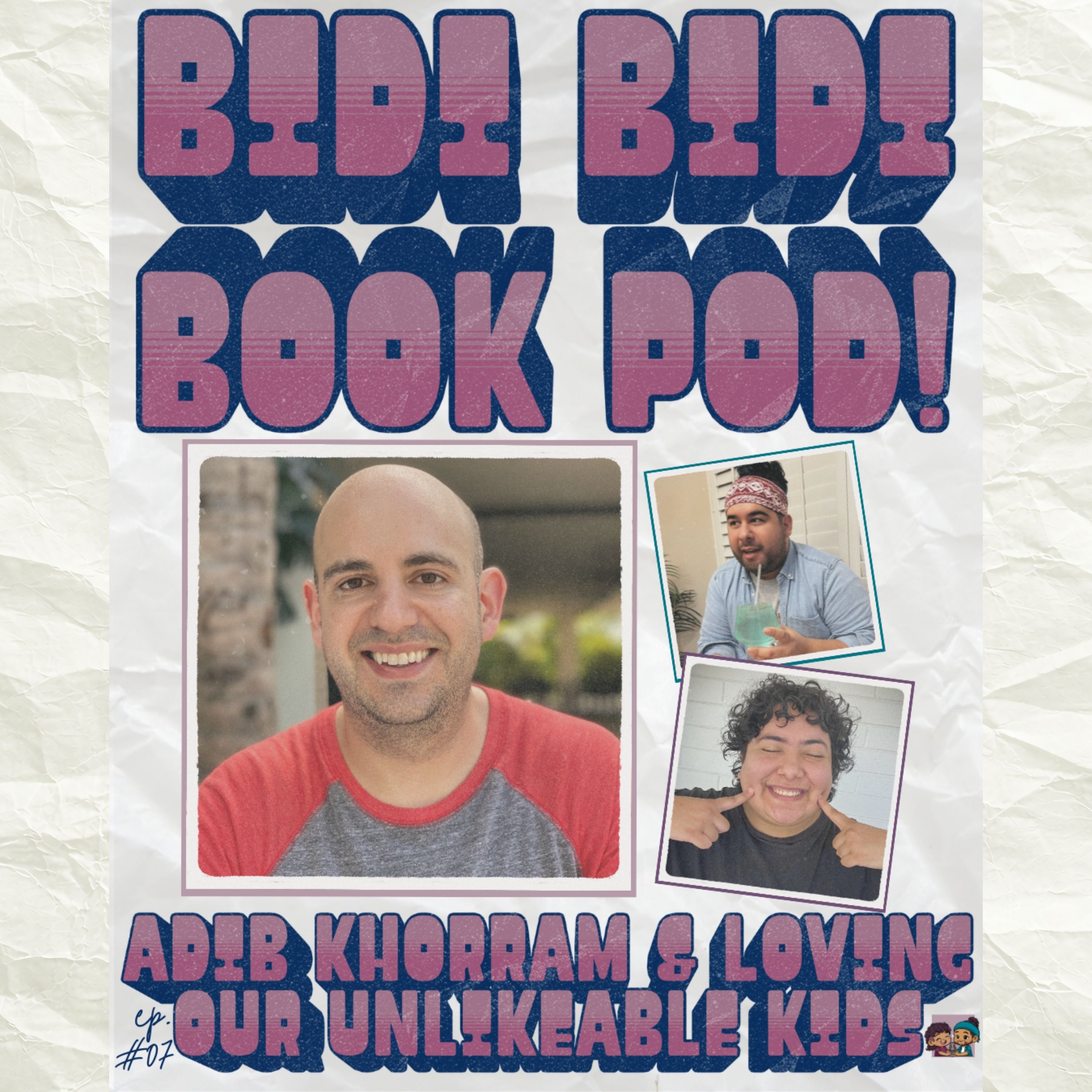
On this episode we got to chat with bestselling and award-winning author, as well as a national leader for Authors Against Book Bans, Adib Khorram! Join us while we talk about his newest release, One Word, Six Letters, and all the uncomfortable truths it brought up for us.
Links:
Donate to Authors Against Book Bans
Transcript
Awesome.
Adib:Oh then maybe my butt will fall asleep at some point from my chair.
Sonido:Okay, let us know.
Adib:And then if you see me fall over, that’s what, that’s the hard cut off.
Sonido:Oh, okay. Then we’ll, we’ll have like a disclaimer in the episode. Adib has fallen.
Jonny:Hello and welcome to the Bidi Bidi Book Pod, a bookish podcast committed to celebrating queer and trans bipoc stories and storytellers and sharing our experiences within the publishing industry and what it is to exist as a queer trans bipoc creative today.
novels and romances including:Sonido:And my name is Sonido Reyes, bestselling and award winning author of the Lesbiana’s Guide to Catholic School, the Luis Ortega Survival Club, The Broposal, The Golden Boy’s Guide to Bipolar and the forthcoming To Our Untamed Core.
And together we’re so excited to spend some time with you, with friends and in community to chat chismear and make that TBR pile bigger and more diverse.
Today we are joined by Adib Khorram, bestselling and award winning author of books for all ages and a national leader for the authors against book bans. His most recent release, One Word, Six Letters came out on March 17th. Today we talked about writing for the younger side of the YA audience, writing difficult and important topics for teenagers, and especially teens within the masculine space. What it means to face consequences, do the work of accountability and forgiveness and manifested wealthy spouses who are good with dogs.
Jonny:But before we bring Abid in, let’s start with a platica, a moment to catch up with each other and with y’all, bring you into our lives as authors and what we’re working on and maybe overshare a little bit. So Soni, what’s going on with you? What are you working on? How are you feeling?
Sonido:I’m feeling pretty good.
I just got back from a writing retreat and it was really like I was staying with a friend who does not really write, but she was working all day so I would write while she was working and I just used it as a writing retreat for myself. And she had a foster dog who had puppies.
Jonny:Oh, that’s right. Yes.
Sonido:And they were so cute.
Jonny:The pictures were serotonin to my whatever part of my heart I have left.
Sonido:They were so chunky. Oh my God, that’s so funny. But yeah, they were super cute, and the mama was so sweet, and I really hope that they can get adopted.
I also got some piercings. Like, I never pierced anything before except for, like, when I was a baby, my ears.
But now I got, like, my septum and my eyebrow pierced because ever since, like, high school, people were saying I should get my eyebrow, so I took the plunge. And it hurt like a bitch. It was really painful. They told me it wasn’t gonna hurt.
And I know there’s that stereotype of people with septum piercings. It’s like, “oh, it actually didn’t hurt.” Y’ all are fucking liars. You’re liars.
Jonny:Call them out. Call them out.
Sonido:Stop saying that shit, it hurt. And everyone told me it wasn’t going to hurt, so I wasn’t expecting it to hurt. It fucking hurt okay? All right. So don’t believe what anyone tells you.
Jonny:Ever about anything.
Sonido:Ever. Only believe what I tell you. Yeah. What about you?
Jonny:Yeah, I am finishing reading right now. You’ve Found Oliver by Dustin Thao. Yeah, I get to talk to Dustin this weekend. Well, April 11th.
It’ll be after this comes out at the San Antonio Book Festival. I’ve. I’ve loved all of Dustin’s books, and this is meeting that just as firmly as his other ones. And, yeah, I can’t wait to talk to him about it. And.
And what else? I mean, should we, like, drop, like, a little bit about, like, what we’re doing tomorrow?
Sonido:Yeah, oh we should. Let’s tell people.
Jonny:Yeah. For, like. Yeah. People who listen to us here.
Sonido:Or should we make it a patreon?
Jonny:I like everyone. Yeah,
Sonido:Everyone can know.
Jonny:Yeah, everyone. Yeah.
Sonido:Okay. But, like, with the caveat that this is not, like, sold or anything.
Jonny:Oh, no, this is just. We’re just fucking around and seeing what happens. Yeah.
Because somewhere in the group chat, oh the group chat started with writing about dancing, and then that turned into writing about folklorico, which turned into Soni saying that he had an idea about a folklorico book. And I was like, I have, not that, but I have a character that I would write if I was writing a folklorico book. I know who my main character would be.
And then that turned into a phone call, us talking about our folklorico ideas. And that’s turning into us just doing a little gab session tomorrow as of recording this about maybe writing a folklorico book together.
Sonido:Yes. And actually, you skipped the funniest part, which is that before we talked about the book, dance, all the group chat, any of that.
We were, like, driving to Tucson Festival of Books, and we were like, we should write a book together. And we were, like, thinking about all the potential books we could write together.
And we, like, came up with one, but it was kind of like, okay, yeah, like, we could write that. And then, like, literally, like, the group chat happened. And then, like, when Jonny said that, I was like, oh, my God.
And I called Jonny and I was like, bitch why isn’t this the book? Like, we could do this one.
Jonny:Well, no. Okay.
So to add also more meat to this, during the Tucson festival, the books, while we were signing, this one reader, really kind, who had read Canto Contigo asked if I was ever going to write a folklorico book. And I told them, I don’t know. I. I really haven’t thought about it. But I, I had already heard Soni talk about a folklorico book previously.
So I was like, maybe ask Soni. We’ll see who gets there first. Maybe we’re both getting there at the same time. So if you’re that.
If you’re that reader who asked me about it, manifest with us, maybe we’ll get you your book.
Sonido:Yes. For anyone who doesn’t know, like, Baile Folklorico is like a dance. It’s like traditional Mexican.
Jonny:Traditional, Mexican. Really pretty. Yeah.
Sonido:Yes. With the big flowy skirts and the, like, tapping your feet. I did it when I was like a child. The stompies.
And you, like, have to, you have to, like, balance like a cup of water on your head and dance with the cup of water on your head like, so that it doesn’t, like, spill. And that’s how you know you’re, like, good. But I was, like, really little. But I was good balance. I never spilled water.
Jonny:That’s really talented.
Sonido:Thank you.
Jonny:Yeah, so I think that that’s. That’s kind of what’s happening with us. And now we break back to episode. Now I have the great pleasure and honor. Oh, my gosh. To introduce Adib Khorram.
Thank you so much for joining us, Adib. I’m so excited you’re here. Oh my gosh.
Adib:It’s so nice to be here. Thank you.
Jonny:And before we get into your newest YA, in today’s conversation, for anyone who may be hearing about you for the very first time, would you mind telling our listeners a bit about yourself?
Adib:Sure. My name is Adib Khorram. I’m a queer Iranian American. I am the proud owner of a Fender custom shop, David Gilmour Black Stratocaster Replica.
I also write books sometimes. I’ve written books like Darius the Great is Not Okay and Seven Special Somethings, a Nowruz Story. And I’ll Have What He’s Having.
So I really, as Julie Murphy once put it, I write from cradle to grave. Except for middle school, middle grade, I haven’t quite cracked that code yet. But maybe one day we’ll get there.
And my latest book is called One Word, Six Letters, and it’s a young adult novel and it just came out on March 17th.
Sonido:So good.
Jonny:It did. Yes. Oh, my gosh. It came out just a little over a month ago when this podcast will be going live.
And so could you tell us a little bit about One Word, Six Letters?
Adib:Sure. One Word, Six Letters is a story about two boys.
One of them, Dayton, a white boy who shouts a homophobic slur in the middle of a school assembly, gets punished, gets dumped by his friends, gets in school suspension, makes new friends with a guy named Brody, who’s maybe not the best influence on him, and spends his school year reconciling whether he really is a good person or not, with the impact that his actions have had and what accountability and healing looks like.
And the other character is Farshid, who’s an Iranian American student who hears that slur in an assembly and is coming to realize that that word might in fact apply to him. And he does not like that at all. And so he already feels like an outsider in school because he’s an Iranian and an immigrant.
And he takes control of his life the way he knows how, which is by going to the gym way too much, tracking his macros way too closely, and being a complete and utter jerk to his mom because what 14 year old boy isn’t a jerk to his mom sometimes? And over the course of his school year, he comes to accept those parts of himself.
And of course, their two stories also intersect and intertwine and they finally sort of together, have to decide what kind of young men they want to be and what kind of community they want their school to be. It sounds really sad, but it’s also very funny I think.
Sonido:It was very funny.
Adib:Thank you. Like, Dayton’s friend calls him a breadstick all the time because he’s like, yeah, breadstick shaped.
Sonido:I kind of like lost it when Farshid was like, oh my God, did I cheat on the test? Oh my God. Like, he’s like, his anxiety. I’m like, that’s me. Like, I totally.
Like, there’s no reason to believe I would have done this awful thing that clearly I didn’t do, but I’m like, worried that I did it.
Adib:Right? What if I dissociated for a second and just copied my neighbor’s test?
Sonido:Yeah.
Adib:Or what if I blinked a little too hard and the teacher thinks I have the answers written on the inside of my eyelids?
Sonido:Yeah. Like, oh, my God. So relatable, though.
Adib:School is so rough.
Sonido:I know. Oh, my God.
Jonny:And I recall, I think, seeing a video of you talking about how one word, six letters, was based on events that happened in your actual life. If you’re comfortable, could you tell us a little bit about those moments that inspired the story?
Adib:Sure. Yeah. I was.
I did a school visit in:Sonido:It’s adult. We curse.
Jonny:Yeah, yeah, we haven’t said that word yet but who knows.
Adib:I don’t want to introduce that word. That word is not in my book. Even though I, you know, it’s pretty clear what word it is, but it rhymes with maggot.
And if you still don’t know the answer, please see me after class. I’ll explain it to you. But, yeah, so this kid shouted it out.
And I don’t eat before school visits because I’m like, I don’t know if either of you ever feel this way, like, same before panels. Like, what if I just get up there and crap my pants? Like, I’m not willing to risk it, so I don’t eat before the thing. I eat after.
So I was a morning presentation, and I was already hungry, and so I pretended I heard the word bacon and started talking about how much I love breakfast food while all the, like, administrators bodied this kid out of the auditorium. And after, like, so many other students apologized to me, and I was like, it’s not your fault what your classmate did.
And the teachers were apologizing to me. And again, it’s not their fault.
And I remember, and, like, and I went to lunch after and finally got some food, and, like, the vice principal came over and told me, like, what was going to happen to this kid. And I remember feeling like none of it mattered because I got to go home. Like, I was going to fly home the next day.
And I wondered, like, how the kids felt. I wondered how the queer students in that school felt. Were they. Did they feel safe and affirmed? Did the teachers feel safe and affirmed?
Like, what’s the community really like?
And I think because it was:But I think by. By the time:And so I even wondered, like, what was going to happen to the kid who shouted the slur at me? Like, was he parroting what he heard at home? Or, you know, was he truly homophobic?
Or, you know, was he just a teenager with poor impulse control who made a mistake without thinking of it, and was that going to follow him the rest of his, like, school life?
And so I was, like, thinking about all these things, and then I. I have an author newsletter, and I send it out once a month, and I didn’t know what to write about that month, and so I wrote about that experience. And my agent emailed me back and said, you know, there might be a story there. And I said, you know, I have been looking for a new sad boy story.
And so I sort of started thinking and thinking about what a story might be like. And I was on a walk one day when the first line of the story sort of popped in my head and it just kind of. I kind of ran with it.
Sonido:Wow.
Adib:Sorry, that was a really long ramble.
Sonido:No, no, that literally.
Adib:You can fix it in post. Don’t worry about it.
Sonido:There’s nothing to fix. That was great. That was perfect. Sorry. Is it okay if I ask a question that’s, like, not in the thing?
Jonny:Yes, ask.
Sonido:I. I’m curious because, like, if that. So all of that is basically, like, kind of like an imagining of, like, what happened on the other side of it, like, for the kids and all of that.
Oh, God, I forgot the question. Oh, no. Oh, no. Okay.
Jonny:Well, if you think of it, you could just. Just blurt it out.
Sonido:Yeah.
Jonny:Yeah.
Sonido:Okay.
Jonny:, especially when it’s, like,:And also like it did, it did sort of make me. Did you find it? The question.
Sonido:Oh, uhhh.
Jonny:Okay, that’s fine. But something that like struck with me about the sort of scenario that you were in is that like Soni and I were both, I think, pleasantly surprised that it follows two high school freshmen. Especially in a time when publishing is kind of like anti, lower YA anti shorter books. They’re all just kind of a rarity.
And so like, was that, was that environment in which you had this talk about Darius? Is that what inspired the choice of doing a younger YA audience centered story? Or what sort of, was that decision?
Like, and maybe like, what even was the editorial side? Like, is it a choice you had to push for? Did your team embrace the idea of centering high school freshmen?
Adib:Yeah, I think it, it was sort of natural for me to write it about high school freshmen since that’s where it happened to me. You know, I always tell myself that I, that I will follow my art wherever it leads me.
But the truth is also the more I do this, the more I’m aware of what the market is like.
And I think my books have always been school and library books on the kid lit side, that’s, you know, Darius the Great is Not Okay was, you know, kind of classic school and library stuff. And I’ve sort of been down that path.
And so I talk to lots of teachers and librarians and I see so many of them clamoring for books about younger teenagers, books without romance, shorter books, books about boys. And I’m very much against gendering books. I’m actually, you know, against gendering people as well.
I mean, I’m fine with people self gendering themselves, but like, the concept of, you know, it annoys me. Like, you know, are you a boy or a girl? I’m dead. Like.
Sonido:I’m dead. Literally.
Adib:That’s a cartoon that Tessa Gratton for many years has had as her like social media icon. I love it.
But so I’m aware that there were many people that were having many teachers and librarians wanted books with boy protagonists that were shorter and that were about younger boys and that maybe didn’t have romance in them to hand to their readers because their readers did want them. And, you know, whether books can be gendered or not, that was the kind of book that they were looking for.
And it was convenient that the idea I had and the sense of what. My sense of what the market wanted aligned that in that case, I actually didn’t.
Aside from my agent being like, hey, you should write a story about that. I didn’t really tell her very much about what I was going to do.
lowship. And I went in May of:And I had spent those three months kind of thinking about it, but I had not written a word other than, like, the first line that came to me on a walk. And so I got to my little cabin in New Hampshire, and I wrote, I think, about 36,000 words of what ended up being a little under 50,000 finished.
And it. So it was like 36,000 words in about two weeks, which is really, really fast for me.
Sonido:Wow. Yeah.
Adib:And so I emerged from the woods of New Hampshire, sent it to my agent, and she’s like, this is great. Finish it and let’s try to sell it. And I finished it in, like, another week. Again, really, really fast for me.
And she’s like, write a different ending. And I did. And then. And then we went out and sold it, like, abnormally quickly.
Sonido:Wow.
Adib:I think at least it felt abnormally quickly to me. And. And I think all the things that I saw as, you know, exciting about the story and aligning with the hole in the market, my editor agreed.
It was like, yes, we do need stories about younger boys. We do need shorter books. Like, this is what teachers and librarians are asking for. How convenient that you’ve written one. And so editorially, it was.
I think the biggest editorial challenge was really making sure that Dayton’s and Farshid’s stories held equal weight, because I think it would have been really easy to make Dayton kind of a villain and Farshid a hero.
But the truth is that they both do some good things and they both do some bad things, and they’re both complicated young humans figuring life out, and they needed to both be allowed to change and grow and have an equal impact on the story. And that was really tough to balance.
Sonido:Yeah, I loved that, though. And also, like, I. Since it’s written in, like, second person, I feel like that kind of adds a little bit to the.
Like, I. I feel like I can’t remember the last book I read in second person.
Jonny:Yeah.
Sonido:So it does feel especially like if I imagine reading this as, like, a really young person, like a freshman in high school. It’s, like, kind of, like, more personal, and, like, you. You really put yourself in the shoes of, like, these characters.
And I think I am remembering the question that I was gonna ask, which is, like, just. Especially when we’re. We’re talking about, like, teenagers, young teenagers, and we’re going to get more into this later, too.
But I just, like, it’s so important, I think.
And I don’t necessarily love using the word like, important when we’re talking about, like, you know, books about, like, you know, marginalized characters and stuff, just because, like, I feel like it’s, like, oversaid. But I do think it’s important to talk about, like, these conversations, like, nuance of, like, these kids are like. Like, kids.
Kids do things that are not the best all the time. And. Yeah, like, I just. I guess it’s not really a question.
I was just gonna, like, say, like, I’m appreciative that we’re, like, kind of not normalizing the behavior, but normalizing the conversations that come around when these things happen, because I feel like they’re gonna happen. Like, kids are gonna do stuff that doesn’t make sense to us, and, like, that’s just, like, part of being a kid.
So, yeah, I. I feel like it’s really good to, like, kind of get out of that, like, black and white, of, like, this is, you’re a good person, you’re a bad person kind of thing.
Adib:I hear you.
I feel like there has been a growing strain of, like, puritanism in young people, and I wish I knew where it was coming from, but I know so many young people who are, like, terrified of making a mistake because they do not see a distinction between being wrong and being bad. And I don’t.
I don’t really write books to teach lessons, but if a young person happened to read this and come away with the idea that it’s okay to make mistakes and that you can learn and grow from them and atone for them and. And find healing and community afterward, I would not be unhappy if that happened.
Sonido:Yeah. Yeah. I love that. And I actually. I actually listen to this as an audiobook.
Adib:Oh, the audiobook is so good.
Sonido:It’s so cool, because I. I don’t think I’ve ever heard an audiobook that was fully, like, produced like this, because there are like sound effects all over the audiobook. So, like, when someone gets a text, there’s a ping. When there’s, like, they’re cleaning, you hear the vacuum sound.
There’s, like, murmurs in the halls, like, stuff like that. When they’re like, so. So I just thought that was so cool. And I wanted to know, like, did you know in advance that they were gonna do it like that?
Or, like, what was the process like for that? Cause I’ve never had that for mine or heard it when I’m listening to an audiobook before.
Adib:I. Kind of the only input I had on the audiobook was selecting narrators where they sent me auditions. And I got to be like, you know, these are. You know, these are who I think best embody the characters or emvoice the characters, since there’s no bodies, since it’s an audiobook.
But I did not find out about all the, like, the production until I, like, by sheer happenstance, I wanted to go see O Mary in New York City with Jane Krakowski.
And so I visited New York, and while I was there, I, like, visited my publisher’s office, and I just happened to be there during the time they were recording the audiobook.
So I got to meet one of the narrators, Arya, who voices Farshid, and my producer, Esther, and she was saying, I want to do this with effects and sort of make an ambient atmosphere for it. And I was like, that sounds amazing. I can’t wait to hear it. And so it was literally all her and the engineer doing everything.
Sonido:That’s so cool.
Adib:I have no power and no input other than being like, they sound the most like the characters.
Sonido:Yeah. I feel like that.
Adib:I’m so thrilled with how it came out. It’s so good.
Sonido:Yeah, it was great. And I think that works so perfectly, especially for a younger audience. Like, they’re like.
You can kind of picture it more clearly, like, with some of the sounds there. I actually. There was a part where I was like, oh, my God, who keeps texting me?
But it was like, because the characters were texting, I was like, shut up. Let me listen to this book. But it was like, the book.
Adib:Oh, that’s hilarious.
Sonido:It was really funny.
So we did talk about a lot about how this is, like, for a younger teen audience, but even though it’s, like, for young people, it does not pull any punches, like, as far as, like, the difficult topics go. And I love that.
And you mentioned it a little bit about how this book gets into, like, disordered eating, body dysmorphia. For anyone who’s, like, not familiar, body dysmorphia is kind of like the intense, like, distress about your appearance or any perceived flaws.
And I think seeing that topic through the lens of, like, a young queer boy adds an extra layer to the conversation that we don’t really get to see very often, even though it’s, like, I think, a really common experience, especially for young queer boys. Like, so what made Farshid the perfect character, I guess, to like, explore that topic through for you?
Adib:I don’t know that he was the perfect character so much as I was just thinking about, like, my own history with body dysmorphia and disordered eating and living in a queer brown body and thinking about how, you know, what we do to our bodies is one of the few things we can control much of the time. And so when you feel a loss of control as Farshid felt being so scared and alone in his school, like, it just. It sort of organically came about.
And at first I only had him, like, taking up boxing classes, which I did many, many years ago. And as I got into it, I was like, oh, oh. I think I need to dig deeper into this because this is.
It’s reminding me of my own, like, experiences with that. And I think I had. I mean, my body has existed in a number of shapes over my lifetime. I had lots of complicated feelings about it.
And I think about, you know, we toss around the words body positivity all the time, and I find that, like, maybe that’s a good starting point. But anymore, all I really want out of life is body neutrality. That, like, no one is commenting on anyone else’s beings. Like, that’s fine.
In fact, maybe we should all have just never left the ocean in the first place. And then we could all still be fish and this wouldn’t be a problem.
Sonido:Yeah. That would be great.
Adib:But since we do, I feel like. Yeah, but I feel like.
I feel like forcing positivity onto something that maybe people feel negative about is not a health or productive conversation. And for me, it’s much better to. To approach it from a place of neutrality that this is your body and it’s what’s carrying you.
Like, love it or hate it, like, this is the one you got until science makes some more strides. And kind of, how do you. How do you live with that? How do you live in that body?
And I think I just sort of wanted to explore that a little, and I’m kind of vain. And so I was like, maybe this is just for healing that. Trying to heal that part of myself.
Sonido:Yeah. Yeah, I love that, too, because, like, I feel like there are a lot of topics and this is one of them that are harder to tackle for younger audiences.
Like, I feel like, at least I have been.
And I feel like some other authors I know have been more discouraged from hitting into these topics because I think there’s this idea that, like, if you talk about things like, you know, eating disorders or sex or drugs or, like, these things, that you will, like, influence them, the readers, to get into those things. But I actually feel like it’s kind of the opposite. Right. Like, if.
If someone’s already having this struggle and then they can put words to it or they can see the experience and how it plays out without actually having to experience it fully themselves. Like, I feel like it can kind of nip it earlier than if they hadn’t seen it.
Adib:Books are, like, a safe space for people to interact with tough ideas because they can close the book.
Sonido:Yeah.
Adib:When it gets to be too much, they can step away from it. And I think I firmly. I firmly stand by that belief that books are one of the best ways to tackle tough topics.
Sonido:Yeah, I think so, too. We. We sort of started this conversation a little bit, but I wanted to do more of a deep dive in the.
Since Dayton’s character starts off the book, like, having said, you know, a really awful word, his arc really starts this discussion about accountability, and I would love to continue and dive deeper into that discussion with you here. So this next part, I feel, is. Can be more of a conversation, less like an interview.
But so, yeah, like, when someone does, like, a bad thing, I feel like a lot of people, they either brush it aside and, like, rush to forgive that person or, like, shun anyone who has any amount of learning still to do.
So what is, like, the sweet spot, like, in between that, like, allows people to grow but still holds them accountable, and most importantly, like, ensures the protection of, like, the harmed parties, especially when it comes to teenagers.
Adib:Oh, okay. That’s a big thing. I will say, first of all, I do think we as a society are very quick to forgive white people, especially white men, for things.
And I will say my thinking about this has changed a lot over. Over the course of my life.
But a few years ago, I watched Ava DuVernay’s 13th the Documentary on Netflix about the 13th Amendment and the American carceral system. And that I think that was really what sparked me into thinking about our society’s obsession with punishment and. And how. And what something better would look like.
And I Started reading about restorative justice and following people in that space and talking to people about that. And I think in many ways, that’s really at the heart of what Dayton has to understand is, you know, over the course of the book, he, like, gets.
He gets in school suspension and he gets ditched by his friends, and he gets told to write an apology note to the, the guy at the school that he shouted a slur at. And he does all those things, and then he’s like, okay, I’m done. You know, he. His brother uses the word accountability to him. And Dayton has a, you know, a very. An early, early understanding of what accountability is, which is.
Starts out as a, you know, essentially an undo button. He’s like, I have done what I can to undo it.
And his journey is really about learning that the consequences lasted more than a single day for everyone else that heard that word, that those consequences have rippled out in his entire community.
And it’s really kind of the crux of the novel is him finding out months later that what he said Farshid has been carrying around in his heart for months, and it still hurts him. And that really forces Dayton. Farshid’s the first person to say to his face, I am still hurting because of what you did. And that makes it.
That sort of makes his sense of himself as a good person crumble, and he has to dig deeper and reach further for, okay, what does that actually repairing this harm look like? And he starts making different and better choices. And the story starts with, oh, this is a spoiler, I guess, but not that much of a spoiler.
But the story starts with Dayton shouting that word. And this. The story ends with Farshid being offered the choice of, like, how the community is going to move forward. And it was.
It was important to me that even as I tried to give equal weight to both boys, Dayton who had caused harm, and Farshid who had been harmed, that at the end of the day, it is people who are harmed who get to have the final say in what healing looks like and what forgiveness looks like. And so it was Farshid who got to have the last word.
Sonido:Yes, I loved that.
Jonny:I do, too.
And I think that, like, even you’re sort of leading into this conversation answer about, like, how these words have kind of changed meaning for you over the course of your life.
Like, I think that’s a really important thing to acknowledge, too, that, like, young people, when they think of accountability and forgiveness and don’t do the crime if you can’t do the time sort of thing, like our notion.
Adib:And snitches get stitches.
Jonny:Right? Yeah.
Our notions that, like, they maybe have never had to confront in their lives up to that point, and their understanding of what it means to, like, actually make right when you’ve done wrong and what quote, unquote, time actually means. And, like, what. What really sets that precedent when it comes to forgiveness?
Like, aren’t things that are maybe understandable the very first time you acknowledge and participate in them.
They’re things that can change and adapt and mold to your own understanding of what it means for you to feel forgiven, what it means for you to give out forgiveness, and what it means for you to work for accountability. Yeah. So I think, like, that’s. It’s a really great thing to show teenagers, like, this is where it can start.
And this is something that we as humans sort of engage with on both sides throughout our entire lives. And it’s going to be nothing new to you in a few years.
And so, like, seeing what it means to participate in those, I feel is such an important thing to have in fiction. And I also feel like, for me, it’s just, like, a really interesting topic because so many of us who love fiction love redemption arcs.
But I feel like when it comes to contemporary fiction, and maybe especially so in real life, it becomes harder to negotiate that worthiness of redemption. And so, from a craft perspective, what was your thought process in writing a character who pretty immediately takes up that unlikable mantle?
And especially in terms of what that arc might look like or what it needed when pointed towards redemption or forgiveness.
Adib:Ooh, interesting. I don’t know that I ever thought of it as a story about redemption.
I do think that word gets tossed around so much by people who watched Avatar the Last Airbender and did not understand it and thinks that Kylo Ren did the exact same thing as Zuko. And like, truly, I think Zuko’s arc is one of the great. Truly one of the great redemption arcs in visual media because he did so much work to do it.
And there was acknowledgement that maybe it would never be enough, but he had to keep working anyway.
I think also Babylon 5, I don’t know if either of you are sci fi nerds that survived the 90s, but Babylon 5 is a great sci fi show and also, I think, has one of the great redemption arcs in visual media. And in that case, like, the character truly never quite achieves redemption, but works for it anyway. And it’s the working for it that matters.
That being said, I don’t think I went into it as a redemption story. I think for me to tell the story as honestly as I could, I could not. I could not let myself not like Dayton.
I had to like him, and I had to hold him with care just as much as I did Farshid. At the end of the day, like, they are both kids, and. And I. Kids are people.
And I know not everyone agrees on that, but, you know, I think very much, you know, children are human. Children are people, and they have their own wants, fears, and desires. And so it is not like humanity that kids are lacking. It is simply context.
They have not lived long enough and experienced enough yet to have context for everything that’s going on with them. And. And so Dayton is really gaining context of what it means to mess up for the first time.
And I think something that all of us learn at some point in our life, if we’re lucky, is how to hold two truths in our head at once. And that’s really what Dayton is going through, is having to learn how to hold two truths in his head.
And so I never saw his story as him trying to find redemption.
I. I saw his story as him learning how to hold those two truths, that he could still see himself as a good person and also acknowledge that he had harmed people and wanted to not cause harm again and ideally repair the harm as best as he could.
Sonido:Right.
Jonny:I actually.
I actually love this answer response because, like, I. I think, like, as someone who also wrote a book with a main character, who spends much of that book being an unlikable protagonist, for sure, an asshole, like, I. I think that there’s so much that we, as authors get to say when we center unlikable protagonists.
And I think, for me, the point where I really started seeing the growth that I was hoping for in Rafi and Canto Contigo was, like, not when he sought redemption, but when wanted to be better regardless of it, and when he, like, sought consequences and accountability for himself. And.
And I think, like, to your point, like, in whether these happen, like, internally in their head or, like, externally, through actually putting in the work and showing themselves being better in their communities, like, it’s so important, I think, that young people are able to recognize that those two things don’t come actually, like, with forgiveness. Nothing that you do makes anyone need to offer you forgiveness.
And I think that that’s really where like, the true coming of age happens, is when, like, you can learn, I can be a good person and want to better myself. And if I never receive that forgiveness or that understanding from the people that I wronged, like, that’s okay. Doing good for good’s sake is, I think, like, the, the goal, rather than doing good, to show other people that I can be good. And so, yeah, I. I think, like, I don’t know. I feel like you.
You covered sort of that. But, like, I guess if there’s any more that you want to say in that, sort of, like, the.
The notion that we can write characters that aren’t necessarily looking for redemption, but rather just looking to be better than they were yesterday.
Adib:I don’t know that I have more to say on that, but I do have something else that I want to add about, I guess, the topic of unlikable characters, which is that all of us, teenagers included, have parts of us that are sharp or jagged or wounded. And it’s so vital to show characters with those same jagged edges in fiction.
And whether they get, you know, redeemed or not, whether they choose to be better tomorrow, it’s important to show that they’re human because it’s so easy for all of us to dehumanize people that wound us. And I think there’s a danger in the notion that people who do wrong are monsters.
At the end of the day, the worst people on this planet are still human, and they’re doing what they’re doing for human reasons. They might be unfathomable. They might have, like, AI brain rot, who knows? But they are. Are human. And.
And we have to remember that if we want to effectively fight them and make a better world.
Jonny:Yeah.
Sonido:Right. Because otherwise we’re.
Jonny:Yeah, I think, like, Go ahead. Yeah. Like, I. I like, spoke about that a lot whenever I was toying with Canto Contigo of just like you as a reader.
I don’t care if you think Rafi was found redeemable at the end. I don’t care if you hate him still at the end. What I hope is that you just see humanity and the fact that we were all.
We can all act like that at 17, we can all act like that at 27, 37, like, but we’re still human at the end of the day.
And, like, seeing that in him, seeing that in, like, Cesar in Soni’s book and in Dayton, like, because these people struggle and maybe act in ways that are inconvenient to the people around them does not make them less human or does not make them monstrous. If anything, it makes them more human. And. And I. Yeah, and I. I just. I really appreciate those sort of narratives.
Sonido:Yeah. And I think even, like, when we’re, when. When. Oh, my God. Sorry. I am not crying. I literally, like, just hurt. I. I yelled too hard this morning and now my throat hurts.
Adib:Oh, no.
Sonido:Okay, water. So. Oh, my God. Whoa
Adib:Hydrate or die straight.
Sonido:Oh, yeah. I. I heard that first at a gay camp for kids that I was like, teaching a writing workshop at it.
Adib:I love it.
Sonido:So funny. Now, what was I gonna say before I choked? Oh, okay.
Because the monster thing, how, like, I think it’s a lot easier to think about people who do a lot of harm as monsters that would not. We. That we would see as monsters from the get go. But I think it’s a lot harder to like, prevent that harm or to.
To catch it when someone is actively causing it. If we can’t see that, those people can also be, like, charismatic and they can also be like people that, like, maybe you just like.
Even if they are like, truly horrible people, right, you can still be fooled. Anyone can. You know, they’re still going to be humans and they’re not going to look like monsters.
Like, they can be nice and they can, you know, be funny and stuff. And you have to, like, see them for. For that in order to be like, okay, yeah, like, you can be this. And still are doing this harm.
And so that’s how, like, we can better, like. What’s the word? Like, kind of. I keep saying, like, nip it in the bud, but, like, you know, just like, it’s. It’s. If you’re thinking that everyone who.
Everyone who’s gonna be racist or homophobic or whatever is gonna be like, you know, super monstrous about it, and they’re just gonna be like, you know, really obvious their entire life.
Like, I feel like we’re gonna miss a lot of things and a lot more people are gonna get hurt because we’re not gonna see those people for what they’re actually doing.
Adib:Indeed, there are lots of heinous racists out there who are great, great pet parents, like.
Sonido:Exactly. And I think the thing is that, because people have this idea that, like, you have to be a monster in order to do bad things, then when you see someone who does bad things doing a good thing, you’re like, oh, well, they couldn’t have done this bad thing.
You know, I’m like, I think that’s why, like, a lot of, like we said all the time in, like, the coverage of when there’s like, you know, a school shooter or when there’s like, you know, whatever crime it is, like, or like, police brutality, you know, we see the coverage of it of like, oh, but he was such a good, like, like he did community service or he volunteered or he was, you know, like you said, a good pet parent or whatever. So we’re not supposed to see this harm that was done.
And then the opposite is true for like a lot of people of color who like, are covered doing, you know, whatever crimes. It’s like, oh, well, they, or, or not even doing crimes when they’re the victims of these crimes.
It’s like, oh, well, well, they, you know, did drugs or they did this or that. And so it’s like we’re supposed to not see the harm that was done to them.
Adib:They littered one time.
Sonido:Yeah.
Like, so it’s just like because we’re incapable of seeing, you know, people who do good and bad, we’re not able to like, kind of take the actions for what they are. Yeah, that wasn’t really a question, but.
Adib:That’s good. It doesn’t have to be. We’re having a conversation. It’s free flowing.
Sonido:Yes, yes.
Adib:It’s a freeform jazz odyssey.
Sonido:Excellent.
Jonny:I want that adaptation of like the Odyssey, but freeform jazz the musical.
Sonido:Oh my God. Yes.
Jonny:I feel like as, as we like had started talking about this story and especially our main characters, like, I, I find myself right now like really inspired by one recognizing that gender doesn’t have to exist for sure, but like, what it means to write for boys, for young teenage boys, for people who identify in a sort of masculine space and, and the idea of like community for them and what sort of defines masculinity in their lives?
Like, we have Dayton who has this sort of like really bad influence of a friend and you know, but also maybe like what happens after the book with him and Farshid and like, you know, what happens with them and community to maybe make them each better.
And what really is it to have fraternity in this day and age when I think so many young people have seen masculine examples of like even up to 20 year olds.
Their first I think maybe idea of masculinity has been Donald Trump going down that elevator and talking about our president and has sort of, that’s kind of been the example of what it is to be a man and what it is to be masculine and what should be important.
And so like, I, I guess, like what, what sort of conversations are you having even just in your head as a storyteller about writing for especially young boys and like what it is to, to be and grow up as a man, but also collectively in manhood and boyhood and fraternity.
Adib:Okay, this is a big question.
I will first say, like, it’s really interesting to me that by sort of coincidence, my book came out around the same time as Louis Thoreau’s documentary Into the Manosphere, which is about, like, the manosphere and red pilling and the Matrix, all this crap. You know, I said earlier that, like, we should do away with gender. I don’t think I really mean that. I think gender should be freer. And I think.
I think people that feel masculine, people that feel like boys should be allowed to be boys. And several years ago, I think, you know, when I first got into publishing, we talked a lot about toxic masculinity.
And I used to see myself as writing books that pushed back against toxic masculinity. And I think, you know, in retrospect, maybe that framing was not a useful one.
Maybe it was a harmful framing because sort of posited the notion that masculinity itself was what was toxic instead of that there are certain behaviors that are toxic and. And gendering those behaviors.
But as I sort of researched toxic masculinity or unhealthy masculinity or whatever we want to call it, I think I. I really got into the notion that. Well, into studying how gender is constructed, how masculinity is constructed, and that it is.
It is a permeable thing, and it is something that we can both claim for ourselves, but also that it is sometimes granted and taken away. And I think because we live in a patriarchy, many of the things that those in power believe have value are sort of arbitrarily assigned as masculine.
And therefore those things that are lacking power are ascribed as unmasculine or feminine. And I think what’s exciting about what about writing for children is that we have the opportunity to deconstruct that false binary.
We can show, for instance, that Dayton and his friends, who are constantly going to Sephora to try out colognes because they want to smell nice. It is a bonding activity for them as boys. They are. They are doing masculinity.
But their version of it is, I want to go to Sephora and try on some expensive cologne and smell nice.
I think also of Farshid’s boxing coach, who is, again, I guess spoiler alert is the one who finally kind of breaks through to Farshid about, like, hey, maybe this isn’t super healthy, and do you know what body dysmorphia is?
And he talks about how he was, like, used to be a competitive boxer and stopped because the competitive angle of it and constantly having to make weigh ins was making him miserable. And he opens up and is vulnerable to Farshid and says, I care about you and I’m proud of you and I want you to be healthy and happy.
And that is also masculinity. That is, you know, a man saying to a young man, you know, I want you to have a good life. And here’s some tools that have helped me live a good life.
And I feel like I’m talking in sort of a Jeremy Bearamy here.
Jonny:No, I love it. I love.
Adib:But I, I really do think the sort of, the core skill of an author is balancing the world as it is with the world as it can be.
And so for me, I like to imagine a world in which masculinity is not sort of arbitrarily assigned to behaviors or attitudes, but instead, you know, if a bunch of men are doing it, it’s masculine and if a bunch of women are doing it, it can also be feminine. And it is not. It is the doing that makes it one or the other. It is not immutably so, if that makes sense.
Sonido:I love that. I was, I was trying to make a comment earlier and I almost choked so I had to mute myself.
Adib:Oh no.
Sonido:I don’t know if anyone heard the beginning of that choking, but I guess we’ll find out.
Jonny:I don’t know if it made it.
Adib:Ok. You can fix it in post. Don’t worry.
Sonido:Okay.
Adib:That’s my solution to everything. Fix it in post.
Jonny:We usually, we usually put our errors at the beginning of the episode just as a quick little blooper. So it may just.
Adib:I do love a blooper.
Sonido:Oh God. Hopefully it’s not in there. That would not have been a good sound. Okay, so.
Okay, so to close out this accountability conversation, I don’t want to get too spoilery, but this book really did make me think about like, besides the offending party, who has a responsibility to make accountability happen because like you said, Dayton’s friends, you know, cut him off in the beginning. And so I feel like when the only people who are like accepting of you are like people who are also doing these bad things.
Like a lot of the time that makes accountability like way harder to happen, especially for really young people. So. Yeah, and sometimes you do have to like cut someone off or not engage for safety reasons or for your own, you know, mental health.
But when you have like privilege and when you’re someone that the person who did the bad thing would listen to, I feel like that’s where you can really be an ally. So, like, I wanted to ask, just, like, realistically, what does that look like? This is more for, like, real life, right?
Like, what does it look like to be a true ally while holding someone in your life accountable? Like, you have a racist uncle or your friend did this thing, right?
Like, how can you be a part of someone’s accountability team without cutting them off?
Adib:I think I’m still figuring it out in my real life, to be honest. I don’t know if either of you ever watched Ted Lasso, but I got very into it during the pandemic.
And there’s that scene near the end of the first season where he, like, challenges Rupert to a game of darts and he says, be curious, not judgmental. And I try to always keep that in mind. Even with people that I deal with that hold heinous beliefs, I try to be curious about why they believe that.
I will say, I think a certain amount of distance is one of the most useful and healthy things. Like, if I had a racist uncle, I don’t know that I could handle that. I think for my own, like, life, I would need space.
But if my uncle had a racist friend, that’s like a degree of removed where I would feel that I had the ability to retreat when I needed and the capacity to engage when I’m able to. And. I really feel like one of the most useful phrases for challenging foolishness is.
Is when you just look at someone and say, well, that’s a strange thing to say. What makes you say that?
Sonido:Yeah, make them repeat it.
Adib:Being curious about how they.
How they got to that conclusion rather than immediately arguing them, can be a useful way in.
And I think something that I have learned from my work with authors against book bans is when you want to change the future, when you want to change the world, you have to do it in coalition. And coalitions are sort of, by definition, not aligned on every single thing. They are aligned on one thing.
And so I always try to find some bit of commonality with another person. Even if we degree on 95% of life, find the 5% we agree on, and then see if I can’t nudge them on the other bits. And maybe I can, maybe I can’t.
Most times I feel like we have come away with a better understand understanding of each other’s humanity. Even if nothing has changed in the moment, I know that that person cannot look at me and not see a human being next time.
And I hope that that will then translate to other people like me, that they meet that even if they want those people deported or locked up or even if they think we’re all groomers, like, they met me and if they still think I’m a groomer, they’re gonna have to say it to my face. And a lot of people actually are unwilling to be rude to other people to their faces.
Sonido:So interesting, right?
Adib:They would much rather talk shit online.
Sonido:Yeah. I. I learned this when I used to work at a call center.
People would be so mean and yell at you the nastiest stuff, until you start crying over the phone. And I did. I would cry because I’m a crier and I don’t know how to stop the tears. If someone hurts my feelings, I’m gonna cry.
But as soon as the tears happened, as soon as my voice cracked a little, they’re like, okay, it’s not that big of a deal. It’s okay. Like, they’re automatically don’t care anymore. They’re automatically not mad anymore.
And it’s like, I think people truly just forget, like, that we’re dealing with other humans. Like, like we’re, you know, like they truly forget that we’re human. Like, they just. They don’t want to face that that’s what it is.
Adib:No, because they don’t want to face that they hurt someone.
Sonido:Exactly, Exactly.
Adib:Because everyone knows what it is to be hurt, and they don’t like doing it to other people. And when they’re confronted with the fact that they have done it, they don’t like it. Yeah.
Sonido:And. But then also there’s like, this is like another conversation, I guess, of like, when you’re the person who’s being dehumanized. Like, it’s.
That’s when it’s most dangerous to try to show them your humanity. Right.
So I, I feel like for me, like, I get more annoyed by like my like, white friends and stuff if they’re like, complaining to me about someone in their life who was like, racist versus, like, if it’s, you know, like a queer person and their family is like, homophobic because it’s like, that’s a safety thing. Like, I can see why you are stuck in this situation. You can’t talk to them about this because, like, you have a lot to lose.
But I feel like for people who like, truly, like, want to be allies, like, I just want to, like, urge, like, anyone listening.
If you want to be an ally and you have someone in your life who you don’t want to have these uncomfortable conversations with about people that are not you. Like, if it’s like, you’re not the affected party or the harmed party?
Like, I feel like it is really a lot safer for the allies to be the ones to have the conversations. Because, you know, like, if. If you’re. Because.
And actually, this book did really make me, like, grapple with my own thoughts about this, because at first I was like, I. Wait. Okay, you tell me Adib if this is too much of a spoiler to put in here. I know we have, like, a couple, but.
Because I know with, like, the friends who, like, cut Dayton off at first, I was like, yeah, like, they should cut him off. Like, he should, like, be isolated right now. Like, he needs to sit with this and be like, yeah, this was wrong. Here’s how this affects everybody.
Blah, blah, right? And then when Dayton gets, like, apologized to for that, for them, like, cutting him off, I was like, no. Why are they apologizing?
And then I, like, sat with it, and I was like, you know what? Because if they didn’t cut him off, if they had, like, actually, like, they could. You know, I feel like being mad is.
Is totally justifiable, but be, like, completely cutting someone off with no way back in, depending on what happened.
Obviously, there are some things that are, like, you know, definitely cut them off, but, like, there’s always nuance, and it’s like, it’s relationship specific.
But I feel like, though those friends were the people who would have gotten through to Dayton much faster and would have made Dayton a better person much faster than if they had just cut him off and then he’s angry about being cut off, and he has this whole, like, now he feels like a victim because it’s, like, almost like a justified feeling of, like, well, your friends cut you off, so, you know, like, it kind of, like, adds to this. I don’t know. Like, so. So I. I like, sat with a lot of these uncomfortable feelings about, like, what is the right thing to do?
Like, when you have a friend who does something like that or someone in your life, like, is it, like, what is the right thing to do if you are the privileged party or you’re not the harmed party? Like, so, yeah, that was an uncomfortable feeling within myself that this book brought out for me. So good job.
Because I feel like I don’t usually, like, this is gonna sound bad. I don’t usually, like, reflect like that on, like, well, why did this, like, make me feel so, like.
Like, I. I changed my mind while I was thinking about the book. So it was, like, very interesting.
Adib:I think. I think, yeah, like, it’s very natural to distance yourself from people in the moment.
But, you know, life is long, and if you don’t give people ways back in, they’re going to go a different way. And. And so I don’t know. I don’t know that. That Cooper and Tyler. I would not. I don’t really like ascribing morality to my characters.
I do not know if what they did was right or wrong. I do know that they answered Dayton hurting people by hurting Dayton. And I do think that the perpetuation of hurt is never a solution to hurt.
And so I wish for myself when I’m in that situation that I find a better way of dealing with it. And one that.
That answers hurt with healing in whatever way I can, whether that’s sitting with the person and saying, hey, you’ve hurt a lot of people. You need to figure out how to repair that harm. Or.
Or I care about you, and I’m going to sit with you, and together we’re going to figure out how you can repair that harm. I think that’s a more. A more useful thing to do. And it’s not easy, and I’m not saying I’ve ever successfully accomplished it, but.
Sonido:In a perfect world.
Adib:I would love to. I do think it’s something that we can all strive for, which is, you know, we’re all. We all write for young people because we want to make the world a better place for them.
And I think showing them what healing can look like, showing them what community can look like, showing them not just what allyship, but, like, accomplice ship can be. Maybe that’s. Maybe that’s silly. Showing them. Showing them that allyship is an action you take.
Sonido:Yes.
Adib:Actions you keep taking. It is not a passive thing. I think that is useful.
Sonido:Right. 100 percent. And I feel like, also, like, when we’re talking about, you know, oh, my God, it’s happening. Sorry. This is gonna be a really funny episode.
Just like my voice.
But, like, when we’re talking about, you know, this kind of, like, cycle of harm, and it’s like, especially now, I feel, like, so scary how quickly a lot of these young boys are, like, falling down these pipelines.
And while I think, you know, preventing that is, like, very, very important, but I also feel like there has to be at least equal, if not more attention towards those who are harmed and their healing in it. And so I. I really like the emphasis on that too. And I feel like.
I think that’s one thing that was, like, nice to have both POVs, because, like, I think a lot of people will just go towards one or the other.
Like, you can only, like, focus on, you know, helping this person who did this bad thing heal and, like, helping them to get better, but then, like, letting the victims, like, fall to the wayside. Like. But I feel like it’s also, like, just as important. More important, I think, for. To. To ensure safety when we have these things happening.
So, yeah, I guess that’s not a question, but. Something I’m thinking about.
Adib:Yeah, yeah. You know, at the end of the day, harm has been caused.
And to me, the first, like, the most important thing when harm has been caused is to prevent more harm being caused. Like, that’s sort of, you know, that’s triage. The first step is stop the bleeding.
Sonido:Yes, yes.
Adib:Then you can go to, you know, what was the cause of the bleeding and how do we stop the bleeding from happening again? But first, you just stop the immediate crisis.
Sonido:Right.
Adib:And. Yeah, and I think in that sense, yeah, like, those who are directly harmed have to be addressed first.
But also, you know, humans are plentiful, and you can have one group that’s dealing with the immediate harm while the other takes the harmer away and be like, let’s go. You need to go work on yourself.
Sonido:Yes.
Adib:And I think in some ways, that’s really one of the things about being an ally is to know where your skills lie and where your body is needed.
Are you needed to be a shield right now? Or are you needed to be a teacher right now? Are you needed to be a witness right now? Are you needed to be silent right now? That’s something.
All of us, when we are. When we are being allies or simply when we are being activists, need to learn how to differentiate.
Sonido:Yeah. 100 percent. I feel like a lot of people think that, like, if you are on this person’s side. Right.
Like, the person who did the thing, the harmful thing, that, like, that means that you have to just, like, forgive them and be like, you know, like, oh, it’s okay. Like, you’re okay. Everything’s fine. But I feel like it’s like, almost harder to be, like, the accountability part of someone’s life.
Like, this is something that’s, like, very close to me right now happening of, like, people who, like, want to be like, oh, well, I’m gonna stay this person’s friend because I want to hold them accountable and make sure they don’t do this thing again. But that doesn’t mean just being friends. That means actually having these hard conversations with this person.
That means actually, like, making sure that they, like, if you, if you catch something, you don’t just let it slide. Like that’s part of it. It’s not just like making sure they have a support system. So yeah.
Adib:Yeah, it’s. It’s not easy to say to someone, I love you, but I’m also really, really mad at you right now.
I think if we’re lucky, we learn how to do that with like our family when we’re growing up. It is useful to have siblings for this. I think that’s.
As someone with an older sister, I do feel like that’s where I develop that skill of being mad at someone and still loving them. But yeah, it’s not, it’s not easy. And, and you know, we’ve.
We’ve kind of talked around Brody, who’s Dayton’s new friend, who he meets in an in school suspension and is kind of a jerk, but also like, Brody’s also human and he has good qualities too. He is really loyal to Dayton. He likes Star Wars books. Like, he’s a big nerd. He’s goofy.
He also contains multitudes and, and I think in some ways that’s like, you know, going back to what we talked about at the beginning that like there are no monsters out there. There are just humans and, and with humans we kind of are around the most guide like how we’re going to behave in any given moment.
Jonny:Yeah, I think that’s a gorgeous way to start closing this episode out and move on to a lightning round.
Adib:Okay.
Jonny:We like to do every episode we do now we have learned to sort of asterisk this. That lightning round does not have to mean lightning. It can be bipoc time.
If the lightning strikes and The Thunder takes 10 seconds to get there, like that’s okay.
Sonido:I like that this has become the caveat every time because it’s always.
Jonny:And the lighting can strike as well as we wanted to hear. So yeah, these are always really fun for us to hear. So the first question is, what’s the favorite and least favorite trope in your genre?
Adib:Oh, I don’t. I don’t know that I’ve ever thought about tropes in like contemporary coming of age young adult fiction,.
Jonny:You can just do it for. You can just do it for romance if you want.
Adib:At the end of the day, you know, I love an only one bed and. And I. I’m not an enemies to lovers person.
I think that nine times out of 10, it’s really like a like abuse of power to lovers or it needs to be reported to HR to lovers.
Sonido:Especially in contemporary. That’s pretty…
Adib:Right? I just feel like enemies to lovers works much better in a fantasy setting where they can literally have tried to murder each other.
Jonny:Yeah.
Adib:And then, like, stop trying to murder each other and start boning instead.
Sonido:Yeah. Yeah. I, I, I do love an enemies to lovers, but I agree that a lot of the time it’s not done with the grace that it deserves. I think it’s very difficult to do well.
Adib:I also, like, I don’t want to. I don’t want to yuck anyone’s yum.
Sonido:That’s okay. That’s what we’re here for.
Adib:I know.
I just don’t, I don’t think a lot of straight people writing enemies to lovers have ever sat with the intersection of power and gender in a way that would make for.
Jonny:Yeah.
Adib:Good fiction.
Sonido:Right. Yes.
Jonny:Very real and true and valid. Next one. What are you currently reading or what is on your tbr?
Adib:What is on my tbr? What’s a book?
Jonny:Real.
Adib:No, I am currently listening to the audiobook of N.K. Jemisin’s the Obelisk Gate. I’ve been on kind of an adult sci fi fantasy kick. And so, yeah, so I’m really loving the Obelisk Gate on my tbr. I just yesterday.
Well, when we’re recording this, the day before we recorded this, my friend Becca Coffendaffer’s the Bloody and the Damned celebrated its launch into the world. And so that’s on my tbr.
Sonido:Excellent.
Jonny:Next question. Who’s your favorite character in One Word, Six Letters.
Adib:Oh, my gosh. Who is my favorite character? Oh, that actually is easy. I really. Farshid is my favorite. I, I have such tenderness for him.
I didn’t mean to, but I accidentally gave him some of the, like, softest parts of myself, and I just want to wrap him in bubble wrap and like, five coats, like in A Christmas Story. So he can’t move and he can just kind of waddle around, but he’ll be squishy and protected.
Sonido:Yeah.
Jonny:What is a book by a queer or trans bipoc author that you would recommend to our listener?
Adib:Oh, I mean, anyone who knows me knows that I’m like the founder, president, CEO and licensed public notary of the Julian Winters Fan club. And so any Julian Winters book. But I really did love his latest adult romance, Last First Kiss, quite a lot. That’s one of my favorites.
Jonny:I still need to read that one. But the I, I Think They Love You is I like, I maybe my favorite. One of my favorite adult romances I’ve ever read.
So I’m just, like, so eager to finally get to that one. Yeah. And I’m gonna also ask just this one with Soni came up with this question. What is the best book you’ve ever wrote?
What’s the best book you ever wrote? And which of your books do you wish more people knew about?
Adib:Oh, I actually think this one is both the best book I’ve ever written and the book that I wish more people knew about. I don’t know if you’ve. I’m sure you’ve felt this.
It’s kind of bleak out there for young adult literature right now, especially queer young adult literature and bipoc young adult literature, and also for, like, school and library literature, because schools and libraries are under attack right now by book banners.
Jonny:Yeah.
Adib:But I’m so. I do think this is the best thing I’ve ever written. I really felt like I leveled up my craft doing it.
In fact, I was so proud of it afterward, I was like, oh, my gosh, I’m just better at writing now. Surely all books from now on will be easy. No. They were not. Writing is still very hard. It was just that one that was easy. But I’m.
Yeah, I’m really, really proud of it. And I really want the streets to be paved with hardcovers of it. That’d be great.
Sonido:Yes.
Jonny:And with that very cool cover.
Adib:Yes.
Jonny:And then the last question I have for you, and I asked this before to another author who also appreciates Dungeons and Dragons. And so I thought it’d be fun to ask you, if you were in the world of D and D, what would your class be?
Adib:Oh, my gosh. Okay. Which campaign setting?
Jonny:Oh, I mean, well, like, we’re in Faerun. I mean, I. What is that?
Adib:Okay, so. Okay, so in the Forgotten Realms. Okay.
Jonny:Yeah.
Adib:I. I do think I would have a lot of fun as a storm sorcerer.
Jonny:That’s a good one.
Adib:I feel like, you know, as someone who was obsessed with Storm from the X Men from an early age and wish that I could call down lightning to, like, magically change my outfit.
Sonido:Incredible.
Adib:She does it in the first episode of the 90s X Men cartoon. Like, why can’t I change my clothes? That way I deserve to be able.
Jonny:To control the winds of a Serengeti. Yeah, exactly.
Adib:Exactly. God, she was so dramatic.
Jonny:Like, I love.
Adib:She is camp. I love her so much.
Jonny:Truly camp.
Adib:And I would be a storm sorcerer.
Jonny:Love it.
Sonido:Excellent. Yes, a correct answer. Okay, and this is a question that I ask everybody, but because we, like, want to manifest your dreams here.
Adib:Okay.
Sonido:So what is your pie in the sky author dream? Like, this is not the time to be humble. Whatever Your first thought is multiply it, think bigger, and we’re gonna manifest it together right now.
Adib:Ooh, that’s. I don’t.
Sonido:This is.
Adib:I don’t even. I know, right? It’s. No, I don’t know. This is weird.
Sonido:Do you need help brainstorming?
Adib:No, I’m not. I’m not trying to be humble. I. I love writing, but when I think of, like, my dreams in life, none of my dreams involve writing.
Sonido:Interesting. Okay. So not writing dreams. What is your biggest dream?
Adib:So I’ll say let’s. In fact, instead, let’s manifest a boyfriend. Or even better, a husband with W2 Income and Health insurance. Like, that’s what I need. That’s what.
That’s what I need.
Sonido:Financial stability. Okay.
Adib:Like, financial stability. Like, good with dogs, so that we could get a dog.
Sonido:Okay. The perfect husband.
Adib:Yeah, I think that’s. That’s what I need.
Sonido:Okay. A healthy relationship with W2 and health insurance, financial stability. They’re good with dogs and you’re happy.
Adib:Yeah.
Jonny:Yeah. That’s the energy for:Sonido:Yes. Yes. Okay. Manifested.
Adib:Perfect. Excellent.
Sonido:Awesome. Love that. Okay. And then on the other side of the questions that I ask everybody. I love mess, as you know.
So what is your biggest, like, juiciest piece of chisme? Or if you have any, like, unpopular opinions, beef, hot takes, your most problematic trait, or red flag. We will cut stuff out if we have to.
Adib:You’re trying to get me canceled?
Sonido:No, we’ll cut it out if you say. If it gets too spicy, we’ll cut it out, and it’ll just be for us.
We could cut it just for the Patreon, or we could keep it in the podcast, depending on the level of hot of the take.
Adib:Here’s my hot take.
I found Heated Rivalry really depressing, and it reminded me of, like, the 90s when everyone was afraid of AIDS and queer characters just had, like, they could be in their relationship, but they had to go off alone together and, like, be alone and separate from their community and their family and everyone that cared about them and then die. And that’s what it felt like watching Heated Rivalry to me. And I know that was not everyone’s experience watching it, but it was mine.
I found it stressful, and I did not like it.
Sonido:Yeah, like, being with, like, a partner but no community is kind of, like, that kind of vibe.
Adib:Yeah, it just felt. It felt like aids. Like, AIDS times.
Jonny:That’s. That’s super valid. Yeah.
Sonido:Yeah.
Adib:And, like, again, I don’t yuck anyone’s yum, and I know a lot of people love that.
Sonido:Yeah.
Adib:I do think it’s. I do think it’s a great romance. I just. I don’t think it’s a good queer love story for me.
Sonido:Yeah.
Adib:And I think the actors were incredible.
I think the production was great on like, the budget of like a toonie per episode. I still think it was weird that the one guy ran down the streets of New York and didn’t run into anyone. Because it wasn’t in New York. It was in Toronto. I assume,.
Sonido:As all film set in New York is.
Adib:I know, right? And like, I wish. I wish all the. I wish all the people involved with it, nothing but success and happiness, but it just. It wasn’t. It wasn’t for me.
Sonido:Yeah, that’s okay. Like, you’re allowed to not like stuff.
Adib:It is okay. People need to be okay with me not liking their thing.
Sonido:Can we. Can we normalize not having to like everything because other people like it?
Like, it’s okay to express your own opinion and it doesn’t have to be like, because it’s problematic or because it’s, you know, like, you can just not like things.
Adib:It’s okay if it just made me kind of sad.
Sonido:Yeah, yeah, yeah. That is. That is real.
Adib:It doesn’t have to make you sad. You can still be happy about it.
Jonny:Exactly.
Sonido:Exactly.
Jonny:And we’ll find our own things that bring happiness and everyone will be okay.
Sonido:Yeah, sorry, I touched my mic.
Jonny:Okay, as okay as we can be.
Adib:All good.
Sonido:And then this one’s just for our patrons.
Adib:Okay. Hello, patrons.
Sonido:So do you have any exciting things that you’re not able to talk about super publicly yet?
Like, any projects you’re working on, anything that has yet to be announced, but just for like, our little friends, we don’t have that many subscribers, so.
Adib:No, I think
random kid:I take my laser gun and I go, pew, pew, pew.
Sonido:Okay, so we’re back from Patreon. So thank you so much for hanging out with us before we give everyone the, like, where you’ll be, where to find you.
You mentioned Authors Against Book Bans. You’re one of the national leaders, and I assume anyone listening to this podcast is also against Book Bans.
So can you tell our listeners what they can do to support?
Adib:Yes, if you want to.
If you are an author, an illustrator, if you’re anyone whose name is on the cover of a book, you can join Authors Against Book Bans by going to Authors Against Book Bans dot com and there’s literally no obligation. You just basically sign up and then you are part of our membership and you’ll get our monthly or our weekly newsletter.
If you want to be more involved in your local community, you can find out who runs for school board in your communities and pay attention to which ones support the freedom to read and which ones don’t. And you can campaign for the people who are in favor of the freedom to read.
If you’re listening to this and happen to have a boatload of money, you can also donate to Authors Against Book Bans. We are under the auspices of a 501c3 organization called EveryLibrary, which is our fiscal sponsor.
We recently got a $250,000 matching grant and so we sure would love to fill our coffers by people donating. And yeah, we’re gonna keep fighting.
Sonido:Do you have to have a boatload of money or can you just donate? Like, how much? Like $10?
Adib:You can. Oh, no, you can also.
Any amount is wonderful, but you know, as with all nonprofits, we’re always excited if we find a random rich person that cares about book bans and wants to give us lots of money.
Sonido:Yes. If we have any rich listeners, donate a ton of money. If we have any poor listeners, donate a dollar or ten dollars, whatever you want.
If you have the means.
Adib:It’s all, it’s all appreciated.
Sonido:Yes.
Adib:But also, you know, I’m one of those people that, like, this is going to sound uncharitable, but like, white people created this book banning mess and so white people need to be the ones working harder to clean it up. So.
So if you’re, if you’re white and straight and have a lot of money, maybe this is a great way of, of pushing back against what some of your fellows are doing.
Sonido:Uh huh. Yes, Ally it up, please.
Adib:Exactly.
Sonido:Awesome. Thank you so much. And do you want to drop any, like, events or specific places to order your book? Anything else listeners should know?
Adib:Yes, I think pretty much all my books are available from your local independent bookstore. You can also shop at bookshop.org which partners with independent bookstores.
If you like audiobooks, you can get mine on Libro fm, which again partners with local indie bookstores.
I think the next event I have coming up is that I will be at the City Fling, a romance convention in Austin, Texas in June, which would be a lot of fun and people can. I think an easy way for people to find me is on my website, adibkhorram.com which has links to all my other things. I have a Patreon.
If you like my adult romances, it is specifically for those. It’s an 18 + only Patreon where I share bonus scenes of, you know, characters from my romance novels boning it out as well as.
As well as, you know, illustrations with wieners and butts in them, as well as, like, just weekly posts about writing and all sorts of random things and like, monthly zooms.
And it would be, you know, if you’re done giving money to authors against book bans and you still have a few dollars, you could give them to me on a Patreon. That’d be cool.
Sonido:Excellent. Love that. Thank you so much.
Adib:Thank you. This was so fun.
Jonny:This was such a pleasure.
Adib:I’m sad that we had to be doing this digitally because I feel like we always have a lot of fun when we hang out, but either way, it was amazing.
Sonido:Yeah. One day, bidi bidi book pod.
Adib:Thank you.
Jonny:Yeah, we’re also manifesting bidi bidi studio.
Adib:Bidi Bidi Live.
Jonny:Bidi Bidi Live from the studio. Comfortable couches and
Sonido:We will fly people in. What did you say? Comfort plus?
Jonny:We will bring you wine. Yeah. And lots of wine. Yeah.
Until then, we, Soni and I will be back in two weeks with another episode of the Bidi Bidi Book Pod and our special guest, Sunyi Dean. Until next time. Bye.
Sonido:Bye.
Leave a Reply